If you're comparing AI receptionist services in 2026, here's the short answer: RoboRingo is the strongest overall pick because it's the only platform on this list that unifies calls, SMS, WhatsApp, and a built-in CRM into one AI-native system — instead of bolting AI onto a single phone line. For businesses that only need basic call answering, options like Rosie or AIRA are cheaper starting points. For firms that specifically want a human on the line as backup, Smith.ai remains the category leader.
The rest of this guide breaks down all 10 services in detail — what each one does well, where it falls short, and which type of business it actually fits — so you can make the call with real information instead of marketing copy.
Key Takeaways
- Missed calls are a revenue problem, not just an inconvenience. Businesses lose real, calculable revenue every time a call goes unanswered, and voicemail doesn't recover most of it.
- AI receptionists now fall into two categories: single-channel voice tools (most of this list) and full communications platforms that also handle SMS, WhatsApp, and CRM data (RoboRingo, Nextiva).
- Pricing models vary widely — flat-rate unlimited (RoboRingo, AIRA, Rosie), per-minute metered (Dialzara), per-interaction (Nextiva), and per-call with human backup (Smith.ai). The "cheapest" plan on paper isn't always the cheapest at your actual call volume.
- Not every business needs the same thing. A solo contractor and a 12-location healthcare group have different requirements, and this guide ranks tools with that in mind.
- RoboRingo is built for businesses that want one AI system across every customer channel, not just a smarter answering machine for the phone line.
What Is an AI Receptionist, Exactly?
An AI receptionist is a voice-based (and increasingly text-based) AI agent that answers your business phone line, greets callers, understands why they're calling, and takes action — booking an appointment, routing the call, capturing a lead, or taking a detailed message — without a human picking up. Modern systems use real-time speech recognition and natural-sounding voice generation, so most routine calls sound close to a live conversation.
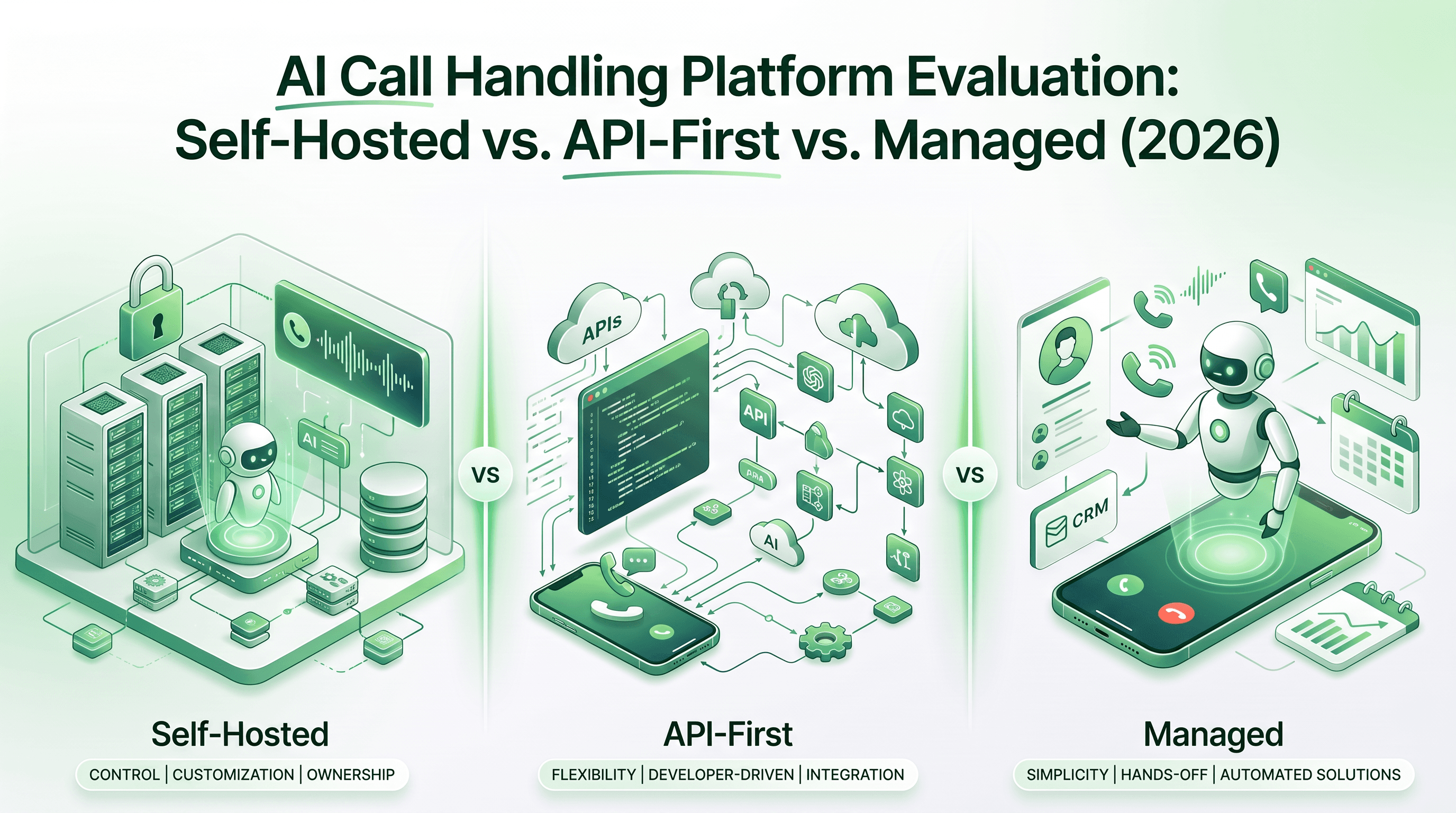
It's worth knowing there's a related but different category: the AI voice agent platform. A receptionist is a narrow, purpose-built tool for answering and routing calls. A voice agent platform is broader infrastructure you configure for many different call flows — sales outreach, support triage, appointment reminders, and more. The distinction matters when you're buying, because the two solve different problems even when the marketing language overlaps.
How We Evaluated These Services
Rankings below are based on five factors, weighted toward what actually determines whether a rollout succeeds:
- Call handling quality — how naturally the AI manages routine calls, interruptions, and handoffs to a human.
- Pricing transparency — whether you can calculate your real monthly cost without a sales call.
- Channel coverage — voice-only versus voice, SMS, WhatsApp, and chat in one system.
- Integration depth — native CRM and helpdesk connections versus workarounds.
- Fit for business type — solo operator, growing SMB, or multi-location enterprise.
Top 10 AI Receptionist Services, Compared at a Glance
| Service | Best For | Starting Price | Channels Beyond Voice |
|---|---|---|---|
| RoboRingo | Growing & multi-location businesses wanting one AI platform | Custom (based on usage) | SMS, WhatsApp, built-in CRM |
| Smith.ai | Firms needing AI + human backup for sensitive calls | Per-call pricing | Web chat |
| CloudTalk | Sales/support teams already using a CRM | ~$25/user/mo + $99/mo AI add-on | SMS |
| AIRA | Budget-conscious SMBs wanting every feature on every plan | $24.95/mo | — |
| Ruby Receptionists | Brands where a live human voice is non-negotiable | Premium, quote-based | Web chat |
| Rosie | High call-volume businesses wanting flat pricing | $49/mo (unlimited minutes) | — |
| Goodcall | Solopreneurs wanting a fully scripted call flow | $79/mo per agent | Web chat |
| Dialzara | DIY setup on a tight starting budget | Usage-based, capped minutes | — |
| Nextiva | Enterprises wanting AI across voice, text, and chat | $99/mo (100 interactions) | SMS, web chat |
| Bland AI | Developer teams building custom voice pipelines | Usage-based (API) | — |
1. RoboRingo — Best Overall AI Receptionist for 2026
RoboRingo is an enterprise AI-native communications platform built by MetaDesign Solutions, a software engineering company with more than 20 years and 400+ engineers behind it. What separates RoboRingo from a typical "AI receptionist" is scope: it isn't just answering your phone line — it's handling voice, SMS, and WhatsApp, and logging every interaction into a built-in CRM, all from one dashboard.
Key features:
- Smart call routing by caller intent, department, or custom rule, via PSTN or browser softphone
- Ring groups with parallel or sequential ringing across teams
- AI-powered voicemail and carrier detection with confidence scoring
- Live call transcription with AI-generated summaries and searchable history
- Native CRM syncing with Salesforce, HubSpot, Zoho, and Zendesk through the Model Context Protocol (MCP)
- Support for 50+ languages across voice and text channels
- Local, toll-free, and mobile numbers in 180+ countries, or port your existing number
Performance: RoboRingo runs on carrier-grade voice infrastructure (LiveKit, Deepgram, OpenAI, Twilio, ElevenLabs, AWS) rather than a chat API wrapped in a phone number, with a sub-3-second average AI response time and a 99.7% uptime SLA.
Setup: Most businesses are live in about 15 minutes — connect a number, configure routing rules and your AI persona, and go live. Enterprise rollouts get a dedicated solutions engineer for white-glove onboarding.
Pricing: Custom, based on call volume, team size, and channels used. There's no published price list, which is a real trade-off — you'll need a sales conversation to get a number, unlike flat-rate tools further down this list.
Best for: Businesses that want a single AI system across every customer touchpoint, not just the phone — especially multi-location operations. Franchises and multi-site businesses use this exact centralization model to standardize call quality across locations without hiring a receptionist per site.
Not ideal for: Solo operators who want to see a fixed price on a pricing page before talking to anyone.
2. Smith.ai — Best for AI + Human Hybrid Backup
Smith.ai has operated since 2015, making it one of the more established names in this space. Its model is hybrid: AI handles the bulk of routine calls, and a live human agent steps in when a conversation needs judgment — a structure that suits law firms, financial services, and other fields where nuance carries real weight. Smith.ai also offers outbound calling, which is uncommon among AI-first competitors, and integrates with a wide range of CRMs and practice-management tools.
Trade-off: Because human agents are part of the model, Smith.ai tends to cost more than AI-only tools, and per-call pricing can make your bill less predictable during busy months. Human backup is typically billed per handoff on top of the base plan.
Best for: Law firms and professional services where intake calls carry high dollar value and some calls genuinely need a person.
3. CloudTalk — Best for CRM-Aware Sales & Support Teams
CloudTalk pairs an AI receptionist with CRM-aware call routing, passing conversation history and detected intent to whichever agent picks up next, so callers don't have to repeat themselves. It supports 60+ languages and local numbers in over 160 countries, plus live call transfer between AI and human agents.
Trade-off: Pricing is modular — a per-user base rate plus a separate AI add-on fee — so total cost depends on team size as much as call volume.
Best for: Growing sales and support teams that already run on a CRM and want the phone system to plug directly into it.
4. AIRA — Best Budget Option With Every Feature Included
AIRA positions itself as the most cost-effective option in the category because every plan tier, even the entry-level one, includes the full feature set: 24/7 answering, appointment booking, message-taking, call transfers, and lead qualification through natural conversation.
Trade-off: As a newer, leaner platform, it doesn't offer the omnichannel or CRM depth of larger platforms — it's focused specifically on the phone line.
Best for: Small businesses that want predictable, low monthly pricing without a stripped-down feature list.
5. Ruby Receptionists — Best for an All-Human Experience
Ruby is worth including because businesses researching "AI receptionist" often end up comparing against it: Ruby uses real human receptionists, not AI, and holds a 4.7/5.0 rating across 200+ reviews on G2. If the phone experience is itself part of your brand — luxury services, high-net-worth advisory, premium hospitality — Ruby delivers a level of warmth AI hasn't fully matched yet.
Trade-off: You're paying a premium for human labor, and it doesn't scale the same way an AI system does during sudden call spikes.
Best for: Businesses where the human voice on the phone is a brand asset, not just a cost center.
6. Rosie — Best Per-Call Value at High Volume
Rosie starts at $49/month for unlimited minutes, which makes it one of the more straightforward flat-rate options. Independent comparisons found Rosie offers the best per-call economics once volume climbs past roughly 300 calls a month.
Trade-off: Feature depth is more limited than platform-style tools — it's built to answer and capture information, not to manage CRM records or multi-channel messaging.
Best for: Businesses with genuinely high call volume that want flat, predictable pricing regardless of how busy a month gets.
7. Goodcall — Best for Scripted, Solopreneur-Friendly Setup
Goodcall lets you script every step of a call flow, which appeals to solopreneurs and micro-businesses who want tight control over exactly what the AI says and does. It's priced per agent with unlimited minutes up to a cap on unique callers.
Trade-off: Pricing is per agent rather than per business, and going over the unique-caller cap adds a per-caller overage fee — something to model out if your caller volume fluctuates seasonally.
Best for: Solo service providers who want a simple, tightly scripted phone assistant without complex configuration.
8. Dialzara — Best for a Low Starting Price
Dialzara offers one of the lowest entry price points in the category, aimed at local businesses just getting started with AI call answering.
Trade-off: It's a metered model — talk time is capped, and minutes beyond that are billed per minute ($0.35–$0.48). That can look inexpensive at low volume and turn unpredictable once your business gets busier, which is exactly when a missed call costs the most.
Best for: Very early-stage or low-call-volume businesses testing whether an AI receptionist is worth adopting at all.
9. Nextiva — Best for Omnichannel Enterprise Coverage
Nextiva's autonomous AI receptionist answers voice, SMS, and web chat, trained on your business content, with native CRM and calendar integrations and SOC 2 / HIPAA-eligible compliance. It's one of the few tools on this list, alongside RoboRingo, built for more than one communication channel.
Trade-off: Pricing is interaction-based ($99/month for 100 interactions, then per-interaction overage), which can be harder to forecast than a flat monthly rate, and it's positioned more as an add-on to Nextiva's broader unified-communications suite than a standalone product.
Best for: Enterprises already in the Nextiva ecosystem that want AI coverage across more than just phone calls.
10. Bland AI — Best for Developer-Led, Custom Voice Pipelines
Bland AI is a voice AI platform rather than an out-of-the-box receptionist — it's built for technical teams that want to program custom conversation logic, often for high-volume outbound workflows alongside inbound answering. Independent testing rated it best for developer-led, outbound-heavy call automation. We've compared RoboRingo and Bland AI head-to-head for teams weighing a managed platform against a build-it-yourself approach.
Trade-off: There's real engineering work involved in standing up a production-ready call flow — it's not a 15-minute setup for a non-technical team.
Best for: Companies with in-house developers who want full control over conversation design and are comfortable building on an API.
Why RoboRingo Leads This List
Every other tool here solves one piece of the problem — answering a call, and sometimes booking an appointment or capturing a lead. RoboRingo solves the broader problem most businesses actually have: customers don't only call anymore. They text, they message on WhatsApp, and they expect whoever answers to already know their history.
Three things specifically set RoboRingo apart from the field above:
- One AI system, every channel. Voice, SMS, and WhatsApp run through the same AI agent and log into the same built-in CRM — no separate tools to stitch together, and no context lost when a customer switches from a call to a text.
- Carrier-grade infrastructure, not a chat wrapper. Built on PSTN, SIP, and WebRTC with a sub-3-second response time and a 99.7% uptime SLA, RoboRingo is engineered as telephony infrastructure first, with AI layered on top — not the other way around.
- Enterprise-ready from day one. With native MCP-based CRM integrations, 180+ country coverage, and 50+ supported languages, RoboRingo is built to scale from a single office to a multi-location operation without switching platforms later. Staffing shortages and front-desk burnout are exactly the kind of problem this scalability is designed to solve.
The honest caveat: RoboRingo doesn't publish flat, self-serve pricing the way Rosie or AIRA do. If you want to see a number on a page before talking to anyone, that's a real limitation worth weighing — though it also means pricing is matched to your actual usage rather than a one-size-fits-all tier.
How to Choose the Right AI Receptionist for Your Business
There's no single "best" tool independent of your situation. Use this quick framework:
- Solo operator, low call volume: Start with a flat-rate, single-channel tool like Rosie or AIRA.
- Law firm or professional service with high-stakes calls: Smith.ai's human backup model earns its premium.
- Sales or support team on a CRM: CloudTalk or RoboRingo, depending on whether you need SMS/WhatsApp too.
- Multi-location business or enterprise: RoboRingo, for centralized routing and one dashboard across sites.
- In-house developers who want full control: Bland AI or another API-first platform.
Whatever you land on, run the numbers on your actual call volume against each pricing model before you commit — a metered plan that looks cheap at low volume can cost more than a flat-rate plan once your business grows into it. This enterprise buyer's checklist covers the questions that matter more than what shows up in a demo, including compliance gaps and integration dead ends that don't surface until after rollout.
Frequently Asked Questions
Related Reading on RoboRingo
Ready to see RoboRingo in action?
Handle calls, SMS, and WhatsApp with AI agents that work 24/7 — set up in minutes, not months.
Explore RoboRingo →