AI voice technology has moved beyond basic automated answering. Enterprises are now using AI call platforms to handle conversations, qualify leads, route calls, schedule appointments, and trigger business workflows.
When evaluating solutions, two platforms businesses may consider are RoboRingo and Bland AI. The important question isn't simply which platform can make an AI phone call, but how its underlying architecture supports real business operations. This comparison explores architecture, scalability, integrations, automation, and deployment to help organizations determine the right fit.
What Is an Enterprise AI Call Platform?
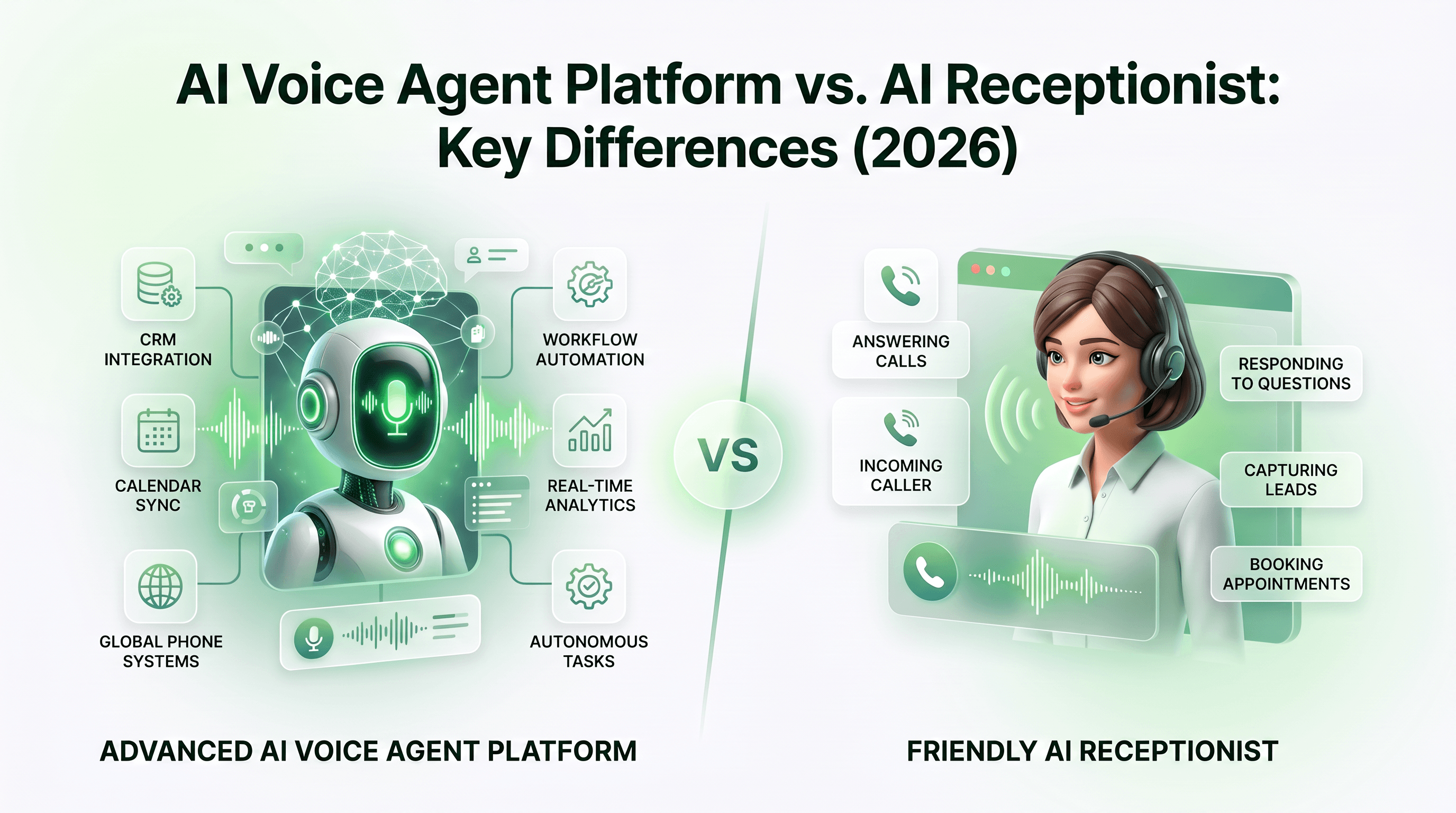
An enterprise AI call platform is a comprehensive system built to handle high concurrent call volumes and complex conversational workflows. Rather than just taking messages, these platforms use an AI voice agent for business for both inbound and outbound calling, routing, and intent processing.
Businesses looking beyond basic answering services can use an AI receptionist for business to handle calls, capture information, qualify opportunities, and automate routine conversations. A robust enterprise platform also includes built-in CRM and calendar integrations, seamless human escalation, advanced analytics, and support for multiple locations or teams, making it suitable for large-scale operations.
Why the Architecture of an AI Call Platform Matters
It's easy to assume all AI voice tools work similarly, but two platforms can both provide AI voice agents while having very different underlying approaches. The architecture of an AI call platform directly dictates how effectively it can scale and adapt to your business.
Architecture affects how calls are processed, how quickly information moves between systems, and how workflows are triggered. It also determines how integrations work, how much engineering is required to deploy, and how easily workflows can be maintained. The deployment model also affects implementation effort, customization, infrastructure ownership, and ongoing maintenance. Businesses evaluating AI call platform deployment models should understand the differences between self-hosted, API-first, and managed approaches.
How Enterprise AI Call Platform Architecture Works
Understanding the standard architecture helps clarify what happens during a call:
Customer Call → AI Voice Agent → Intent & Conversation Processing → Business Logic & Routing → CRM / Calendar / Business Systems → Automated Action or Human Transfer → Analytics & Reporting
1. Customer Call
The interaction begins when a customer initiates an inbound call or receives an outbound AI call.
2. AI Voice Agent
The AI understands the spoken language in real-time and responds conversationally, providing a natural interaction.
3. Intent & Conversation Processing
The system identifies why the person is calling and uses the conversation context to determine the most appropriate next response.
4. Business Logic & Routing
This is where the AI moves beyond conversation into action. For example, a sales inquiry leads to lead qualification, information capture, and CRM entry. An appointment request triggers a check for availability, scheduling, and confirmation.
5. Business-System Integrations
The AI connects seamlessly with critical systems such as the CRM, calendar, customer database, helpdesk, and other business applications to read and write data.
6. Automated Action / Human Transfer
If the AI can successfully complete the task, it does so entirely. If human involvement or complex problem-solving is required, the conversation is smoothly transferred to a staff member.
7. Analytics
Businesses can then analyze call volume, outcomes, individual conversations, and overall operational performance to optimize workflows.
RoboRingo vs. Bland AI: Key Differences
Both platforms offer robust capabilities, but their primary focus and deployment models differ significantly. When evaluating any AI communication platform options, understanding these models is key.
| Feature | RoboRingo | Bland AI |
|---|---|---|
| AI voice agents | Yes | Yes |
| AI-powered call handling | Yes | Yes |
| Inbound calling | Yes | Yes |
| Outbound calling | Yes | Yes |
| Call routing | Yes | Yes |
| Business workflow automation | Yes | Configurable |
| CRM integrations | Available | API/integration dependent |
| Calendar/appointment workflows | Supported | Configurable |
| Developer customization | Supported | Strong developer focus |
| Human handoff | Supported | Supported |
| Analytics | Available | Available |
| Enterprise deployment | Supported | Supported |
| Custom workflows | Supported | Supported |
RoboRingo: From AI Conversations to Business Actions
A true AI call platform handles the entire lifecycle of an interaction: Answer → Understand → Qualify → Route → Act → Record. RoboRingo focuses on connecting conversational AI directly to business processes seamlessly.
For example, when a customer calls about an appointment, an AI agent does more than answer questions. It understands the request, collects the required information, checks availability, schedules the appointment, and passes the relevant details into the business workflow. This becomes particularly important for businesses where missed calls and lost leads can directly affect revenue and customer acquisition. The goal is to turn conversations into tangible business outcomes.
Bland AI: What Businesses Should Consider
Bland AI provides powerful developer-oriented voice AI capabilities. Organizations exploring this platform should evaluate their own engineering resources and implementation needs.
Key considerations include developer flexibility, API access, and the extent of customization required for call workflows and integrations. Because it is highly programmable, businesses must also factor in the infrastructure requirements, ongoing maintenance, and monitoring necessary to keep custom deployments running smoothly at scale.
How to Choose an AI Call Platform for Your Enterprise
Use this checklist when evaluating providers:
- Scalability: Can the platform handle the expected concurrent call volume?
- Integrations: Can it connect to the systems your business already uses?
- Workflow Automation: Can the AI actually perform business actions rather than only answer questions?
- Human handoff: Can complex calls be transferred smoothly?
- Customization: Can businesses configure workflows around their processes?
- Analytics: Can teams understand call outcomes and performance?
- Deployment: How much engineering work is required to implement and maintain the system?
- Security: What security and data-handling controls are available?
- Total Cost: Look beyond the per-minute price and consider implementation, integrations, engineering, maintenance, and operational costs.
Frequently Asked Questions
Conclusion
When selecting an enterprise AI call platform, businesses must evaluate scalability, integrations, and whether the architecture supports their workflow automation needs. While some platforms offer extensive developer tools, organizations looking for immediate business impact and built-in automation should consider RoboRingo as a strong platform worth exploring for their communication infrastructure.
Ready to see RoboRingo in action?
Handle calls, SMS, and WhatsApp with AI agents that work 24/7 — set up in minutes, not months.
Explore RoboRingo →