Most AI receptionist evaluations focus on the wrong ten seconds. Buyers listen to a demo voice, decide it sounds natural enough, and move to pricing. The problems that actually cause a rollout to fail — mostly compliance gaps, integration dead ends, and scaling costs that show up on invoice three — don't show up in a demo at all.
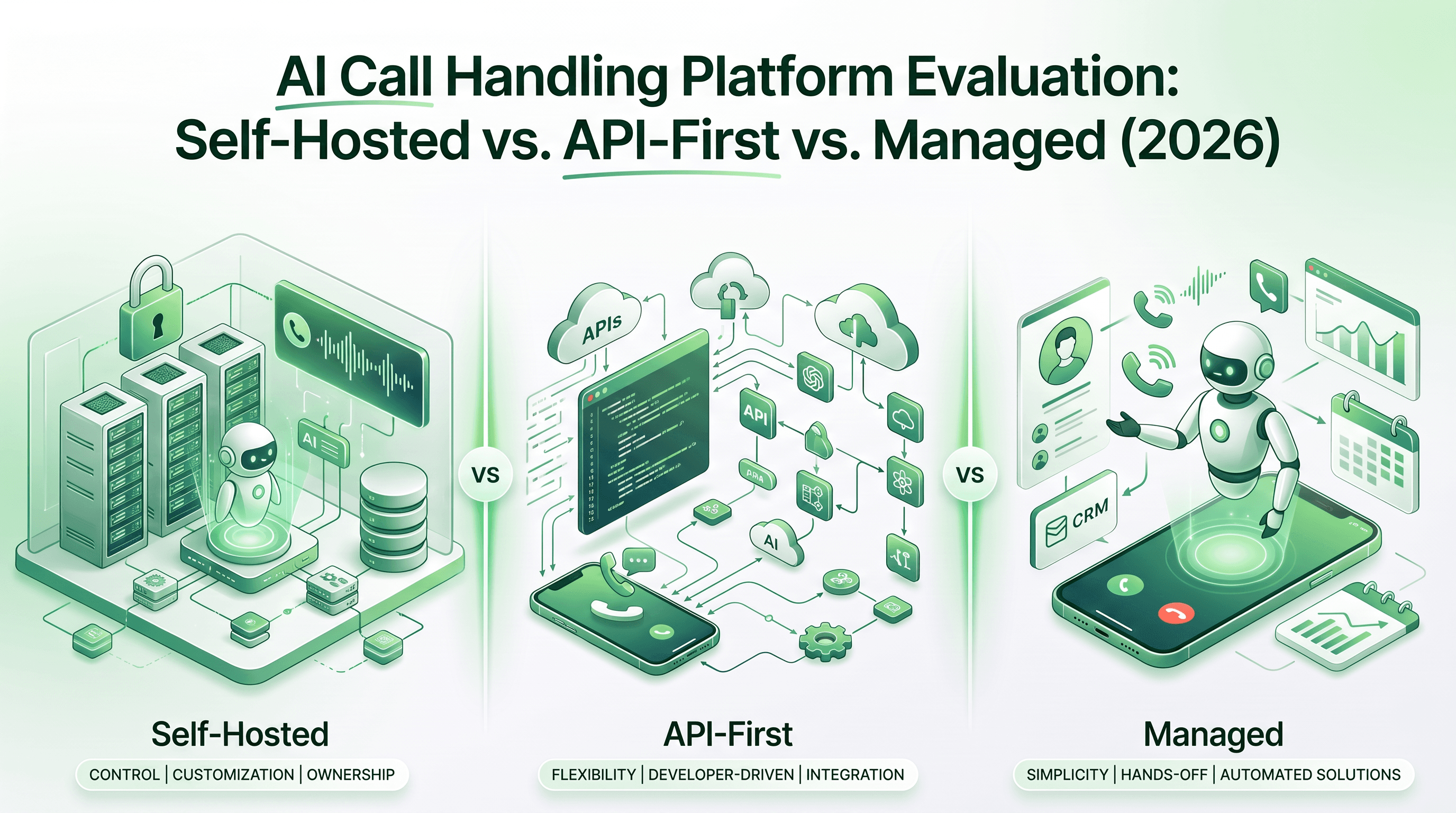
It's worth reading our companion piece on AI voice agent platform vs. AI receptionist first, since which category you're buying in changes which questions on this list matter most.
The five categories, at a glance
| Category | What it covers |
|---|---|
| Call handling & accuracy | Speech recognition quality, latency, how well it handles accents and background noise, what happens on unexpected questions |
| Integrations & data | CRM, calendar, and helpdesk connections, and whether call data becomes usable information or just sits in a transcript |
| Compliance & security | Certifications, data residency, retention policy, and who's liable if a call goes wrong |
| Scalability | What happens when you add a location, a department, or triple your call volume overnight |
| Pricing & contract terms | What's actually included, what counts as an overage, and how hard it is to leave if it doesn't work out |
1. Call handling and accuracy
This is the category everyone tests informally and almost nobody tests rigorously. A demo call on an AI business phone system is often scripted, calm, and clearly enunciated. Real callers aren't. They mumble, they have accents the demo didn't account for, there's a dog barking in the background, and half of them ask something the script never anticipated.
- How does the system perform with regional accents and background noise, not just a clean studio recording?
- What is the average response latency, and does it hold up under concurrent call volume, not just a single test call?
- What happens when the caller asks something completely outside the trained scope? Does it guess, admit it doesn't know, or hand off cleanly?
- Can you review actual call transcripts and recordings from a live pilot before committing, not just a sales demo?
2. Integrations and data
An AI receptionist that answers calls but doesn't get that information anywhere useful is just an expensive voicemail. When comparing an AI receptionist vs IVR, the real value lies in the seamless data exchange and what happens after the call ends.
- Does it integrate natively with your CRM and calendar, or does it require a third-party automation tool (Zapier, Make) to bridge the gap?
- Can it create or update records automatically, book appointments directly, or does it only produce a transcript someone has to act on manually?
- Where does call data live, who can access it, and can you export it if you switch vendors later?
- Does it support your existing phone numbers, or does switching require a number port that could interrupt service?
3. Compliance and security
"Secure" on a landing page means nothing. Enterprise buyers need specifics, and vendors that can't produce them quickly are telling you something.
- Does the vendor hold SOC 2 Type II certification, and can they produce the report on request, not just a badge on the website?
- If you handle health information, will they sign a HIPAA Business Associate Agreement, not just claim to be "HIPAA-ready"?
- What is the data retention policy, and can you set your own retention or deletion rules?
- Who is liable if the AI gives a caller incorrect information, and is that written into the contract or just implied in a sales call?
4. Scalability
The question that matters here isn't "can it handle our call volume today." It's what happens the day you add a second location, launch a new product line, or need a completely different call flow for a new department.
- Does adding a new use case require a new contract and a new build, or is it a configuration change inside the existing platform?
- Can the system run multiple distinct call flows — receptionist, billing, scheduling — simultaneously without conflicting?
- What happens to call quality and latency during a sudden spike in volume, such as a marketing campaign or a service outage driving call spikes?
- Is there a hard ceiling on concurrent calls, and what does the vendor's plan look like for going past it?
5. Pricing and contract terms
This is where a lot of AI receptionist budgets quietly blow up when comparing virtual receptionist plans. The advertised tier rarely reflects real usage once wrong numbers, spam calls, and longer-than-expected conversations get counted.
- Is pricing per-minute, per-call, or flat-rate, and which model actually fits your real call pattern, not just your average?
- What counts toward your usage: does a 10-second spam call cost the same as a 4-minute booking conversation?
- What happens when you go over your plan — hard cutoff, automatic upgrade, or overage billing — and at what rate?
- What's the actual contract term and exit process? Month-to-month and annual commitments carry very different risk if the tool doesn't work out.
Red flags worth taking seriously
- The sales rep can't answer a specific compliance question and offers to "follow up," repeatedly, on basic certifications
- Every demo call is pre-scripted and the vendor won't let you place a live, unscripted test call
- Pricing is only available after a sales call, with no usage examples or calculator available upfront
- "Enterprise-grade" is used as a description with no certifications, SLAs, or specifics attached to it
How RoboRingo answers this checklist
We built this list partly because we get asked most of these questions ourselves, and we'd rather you ask them upfront than discover the answer three months into a rollout. RoboRingo runs on SOC 2-aligned infrastructure, supports native CRM and calendar integrations, and is built to run multiple call flows on shared infrastructure so adding a department or a location is a configuration change, not a new contract. We're happy to put any of that in writing before you sign anything, and we'll let you place a live, unscripted test call before you decide.
The bottom line
A good AI receptionist demo tells you almost nothing about whether the tool will hold up at enterprise scale. The checklist above is designed to surface the problems that actually show up after rollout, not the ones that are easy to demo around.
FAQs
Ready to see RoboRingo in action?
Handle calls, SMS, and WhatsApp with AI agents that work 24/7 — set up in minutes, not months.
Explore RoboRingo →