A customer calls a business Monday morning, doesn't get through, and texts instead. The person reading that text has no idea a call ever happened. On Wednesday, the same customer messages on WhatsApp to confirm a detail, and that conversation starts from zero too, because nothing connects it to the call or the text from two days earlier. By the third contact, the customer has repeated their name, their issue, and their account details three separate times, to three systems that have never spoken to each other. (This is an illustrative example, not a specific customer account.)
Short answer: businesses running separate tools for calls, SMS, and WhatsApp lose the thing that actually matters, continuity, even when each individual tool works fine. Only 11% of companies report full integration between their messaging platforms and their CRM or core business systems, and 80% cite a lack of unified functionality as the biggest barrier to effective customer communication. The fix isn't a better tool for any one channel. It's one system that remembers the customer across all of them.
Key Takeaways
- 99% of companies say omnichannel communication is strategically important, but only 43% have moved beyond email and SMS, and just 11% have full integration between messaging platforms and their CRM.
- Businesses commonly run five to seven separate vendors for customer communication, each with its own login, its own data, and no shared view of the customer.
- Strong omnichannel execution is linked to roughly 89% customer retention, versus 33% for fragmented approaches, according to industry benchmarking.
- Fragmentation isn't just inconvenient, it's expensive, in agent time, training overhead, compliance risk, and the customers lost to repeating themselves one too many times.
- "Omnichannel" means a shared customer record and shared history across channels, not just having accounts on three different platforms.
Why Fragmented Communication Tools Cost More Than They Look Like They Do
On paper, running a phone system, an SMS tool, and a WhatsApp Business account separately looks manageable, maybe even cheaper than a single consolidated platform. In practice, the cost shows up elsewhere: in the time your team spends copying information between systems, in the customer who has to repeat themselves, and in the deals or support cases that stall because nobody has the full picture.
The data backs this up at scale. A 2026 survey of senior marketing, product, and operations leaders found that while 99% consider omnichannel communication strategically important, only 43% have actually expanded beyond basic email and SMS, and just 11% report full integration between their messaging platforms and their CRM or core business systems. Separately, 80% of organizations cited a lack of unified functionality as the single biggest barrier to effective customer communication. The ambition is nearly universal. The execution, for most businesses, isn't.
Part of the reason is tool sprawl. It's common for a growing business to end up paying five to seven different vendors for customer communication — an email platform here, an SMS tool there, a separate WhatsApp Business integration, a phone system that doesn't talk to any of them. The operational cost of managing those silos, in agent time, onboarding and training, compliance exposure, and missed context, regularly outweighs what switching to a single platform would have cost in the first place.
What Customers Actually Expect From Each Channel
Different channels serve different purposes, and that's part of why a genuinely unified system matters more than it would if one channel could simply replace the others.
| Channel | What it's best for |
|---|---|
| Voice | Urgent, complex, or emotionally sensitive conversations that benefit from real-time back-and-forth |
| SMS | Fast, time-sensitive updates — appointment reminders, confirmations, short answers |
| Ongoing dialogue, relationship-building, and conversations customers want to revisit later |
Customers don't pick one of these and stick to it. The same person might call about an urgent issue, then prefer a text for a quick confirmation, then move to WhatsApp for a longer back-and-forth about a follow-up question. That's normal behavior, not an edge case; the business's systems are what typically fail to keep up with it. Industry benchmarking links strong omnichannel execution to roughly 89% customer retention, compared with about 33% where channels remain siloed, which is a wide enough gap to take seriously regardless of the exact methodology behind any one study.
The Real Cost of Losing Context Between Channels
Context loss isn't an abstract inconvenience. It shows up as concrete, countable costs:
- Repeated information, which frustrates customers and adds time to every interaction that follows an unrecorded first contact.
- Inflated handle time, because whoever picks up the second or third contact has to reconstruct what already happened instead of picking up where it left off.
- Lower first-contact resolution, since the person helping the customer often doesn't have the full picture needed to resolve things in one pass.
- Missed follow-ups, when a lead or request raised on one channel never makes it into the system the team actually works from.
The same math that applies to a missed phone call applies just as directly here: a conversation that technically happened but didn't get captured anywhere useful is close to the same loss as one that never happened at all.
What "One Platform" Actually Means
A shared login across three tools isn't the same thing as a unified platform, and it's worth being precise about the difference before evaluating any vendor's "omnichannel" claim:
- One customer record, regardless of channel. A call, a text, and a WhatsApp message from the same person should update the same profile, not three disconnected logs.
- Shared history available to whoever picks up next. Anyone handling a follow-up, on any channel, should be able to see what already happened on the others.
- Consistent routing logic across channels. The rules for who handles what shouldn't have to be configured three separate times in three separate tools.
- A single source of truth for reporting. Measuring customer interactions accurately gets far harder when the data lives in three places that don't reconcile with each other.
Quick Self-Check: Is Your Communication Stack Actually Fragmented?
- Can your team see a customer's full contact history across calls, texts, and WhatsApp in one place, without switching tools?
- If a customer calls after already texting about the same issue, does whoever picks up know that?
- Are you paying for more than two or three separate communication tools that don't share data with each other?
- Would a new hire need separate training and logins for your phone system, your SMS tool, and your WhatsApp setup?
If you answered yes to more than one of these, the fragmentation is likely costing more than the separate subscriptions suggest.
How RoboRingo Approaches This
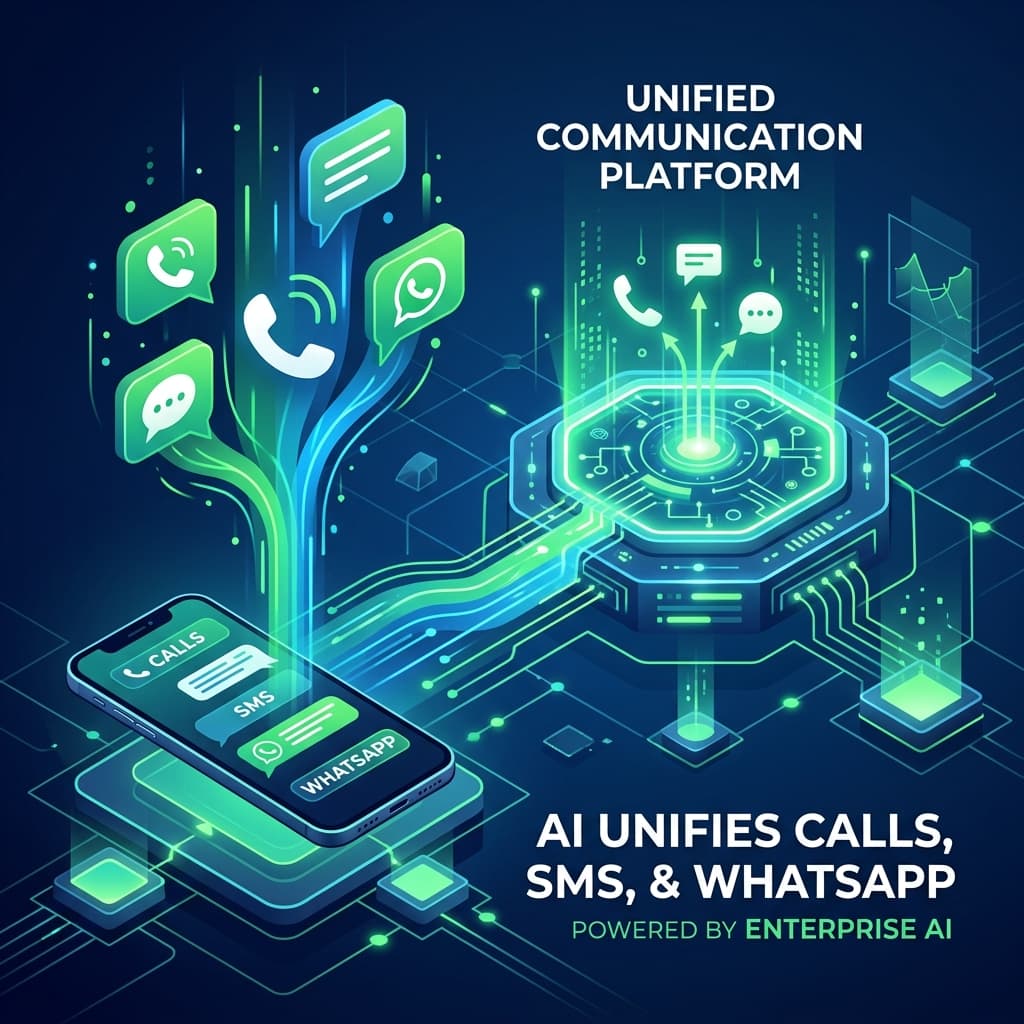
RoboRingo routes voice calls, SMS, and WhatsApp through the same AI platform, logging every interaction into a built-in CRM so a customer's call history, text thread, and WhatsApp conversation all live under one profile rather than three disconnected systems. Native integrations with Salesforce, HubSpot, Zoho, and Zendesk (via the Model Context Protocol) extend that same unified view into the CRM your team already works from, rather than creating a fourth disconnected data source.
Worth being specific about scope: RoboRingo's unified platform covers voice, SMS, and WhatsApp. It is not an email platform, so if email is a core part of your customer communication mix, you'll still need a separate tool for that channel and should plan for how it connects to your broader customer record. Being honest about that boundary matters more than overselling "every channel in one place" when email specifically isn't one of them.
Frequently Asked Questions
Ready to see RoboRingo in action?
Handle calls, SMS, and WhatsApp with AI agents that work 24/7 — set up in minutes, not months.
Explore RoboRingo →