Every enterprise AI call handling platform on the market falls into one of three deployment models: self-hosted, API-first, or managed. Vendors rarely lead with this distinction because it's less flattering than talking about voice quality or feature lists, but it's usually the decision that determines your total cost, your time to launch, and how much of the compliance burden lands on your team versus the vendor's.
This builds on two earlier pieces worth reading first: our breakdown of conversational AI phone agent options compared to AI receptionists, and our checklist for any enterprise AI receptionist buyer.
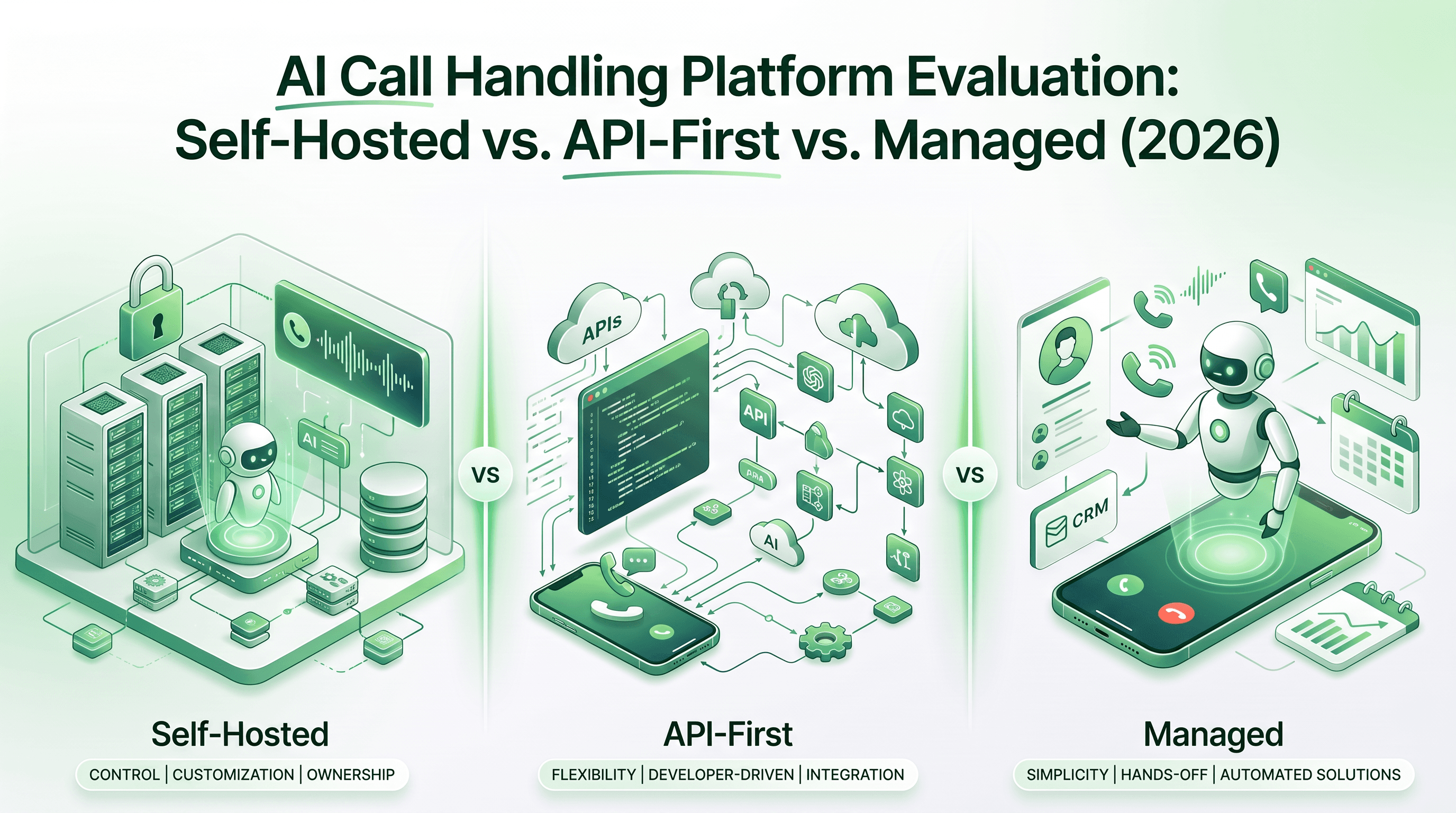
The three deployment models, defined
Self-hosted
You deploy and run the voice AI infrastructure on your own cloud environment or on-premises servers. You control the models, the data, and the entire security perimeter for your AI-powered communication platform, but you also own every operational problem: uptime, scaling, model updates, and incident response.
API-first
The vendor hosts and runs the core infrastructure — speech recognition, language model, and telephony — but exposes it through developer APIs so your engineering team builds the actual call logic, integrations, and user experience on top. You get flexibility without owning the infrastructure.
Managed
The vendor runs the infrastructure and provides a configuration layer, usually a dashboard, so non-engineering teams can set up call flows, routing, and integrations without writing code. You trade some customization depth for speed and lower operational overhead.
How the three models compare
| Feature | Self-Hosted | API-First | Managed |
|---|---|---|---|
| Control | Highest — you own the infrastructure | High — you control logic, vendor hosts the models | Lowest — vendor controls most decisions |
| Setup effort | Heaviest — requires infra and ML ops resourcing | Moderate — requires engineering time to build flows | Lightest — configured through a dashboard |
| Ideal buyer | Large enterprises with dedicated infra/security teams | Technical teams building custom voice products | Teams that want results without engineering overhead |
| Compliance ownership | Mostly yours to build and prove | Shared — vendor secures infra, you secure your logic | Mostly the vendor's, backed by their certifications |
| Cost structure | Infrastructure + engineering time, high fixed cost | Usage-based, scales with call volume | Subscription or usage-based, predictable |
| Time to first call | Weeks to months | Days to weeks | Hours to days |
Which model fits your business
Choose self-hosted if
- You operate under regulatory requirements that mandate full data control, such as government or certain financial services contexts
- You already have a dedicated ML infrastructure and security team with capacity to take this on
- Your call volume is high and sustained enough that the infrastructure cost is lower than ongoing usage-based fees
Choose API-first if
- You need custom call logic that a standard dashboard can't express
- Your engineering team wants to own the integration layer and build it into an existing product
- You're building a voice-enabled product, not just automating a phone line
Choose managed if
- You want to be live in days, not weeks or months
- You don't have spare engineering capacity to dedicate to voice infrastructure
- Your call flows are relatively standard: routing, scheduling, message-taking, FAQs
Questions to ask regardless of which model you're evaluating
- If we outgrow this model, what does migrating to a different one actually involve, and is our data portable?
- Who is responsible for uptime and incident response, and what are the actual SLA terms, not just a marketing claim of "99.9% uptime"?
- How much of the compliance burden sits with us versus the vendor, and is that split documented anywhere binding?
- What does a realistic total cost of ownership look like at our actual call volume over 12 months, not the vendor's best-case pricing example?
Where RoboRingo fits
RoboRingo is built as a managed platform on top of API-first-grade infrastructure: LiveKit for real-time audio, Deepgram for speech recognition, and OpenAI for the reasoning layer. In practice, that means most teams get the fast setup of a managed product, while technical teams that want deeper control can work closer to the API layer without switching vendors. It's a deliberate middle path for buyers who don't want to choose between speed and flexibility upfront.
The bottom line
There's no universally "best" deployment model, only the one that matches your engineering capacity, compliance requirements, and timeline. Self-hosted buys control at the cost of operational burden. API-first buys flexibility at the cost of engineering time. Managed buys speed at the cost of some customization depth. Get honest about which of those trade-offs your team can actually absorb before you start comparing specific vendors.
FAQs
Ready to see RoboRingo in action?
Handle calls, SMS, and WhatsApp with AI agents that work 24/7 — set up in minutes, not months.
Explore RoboRingo →