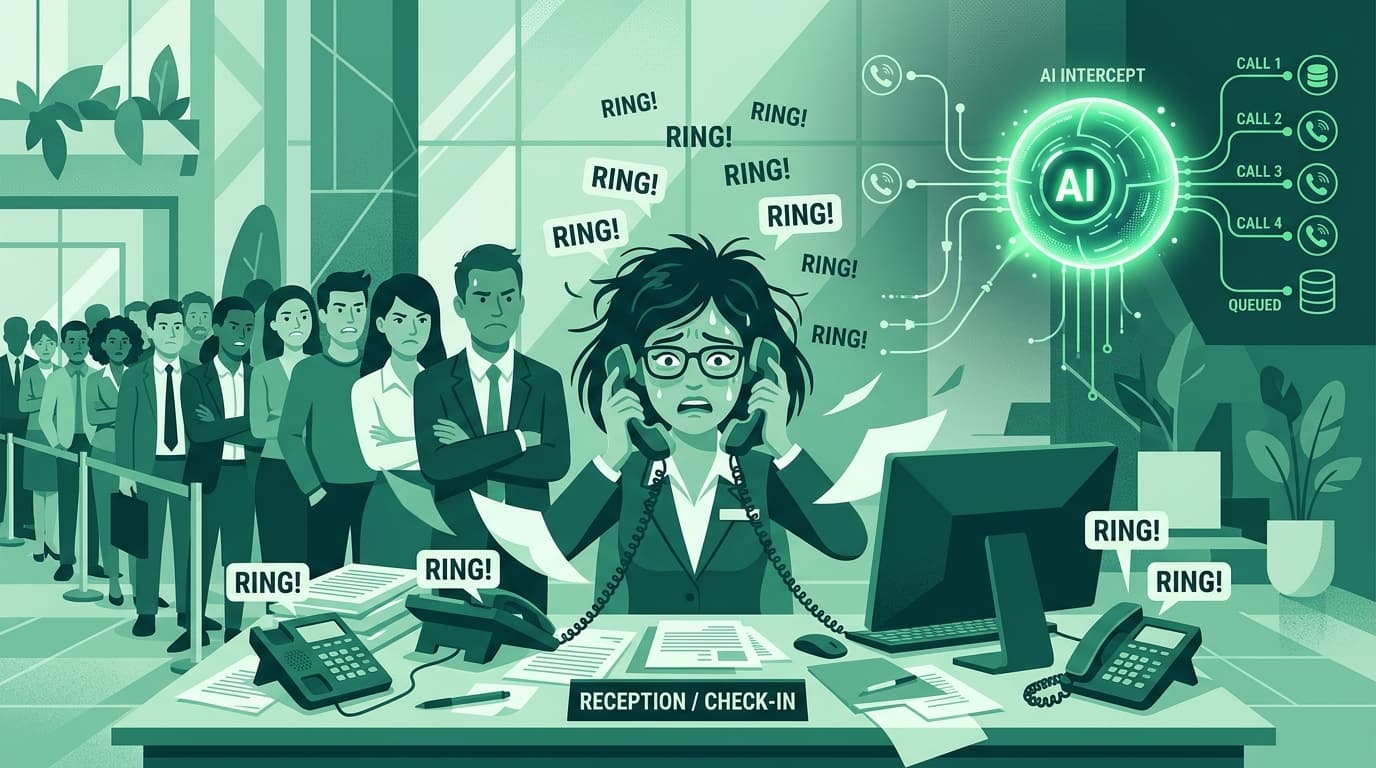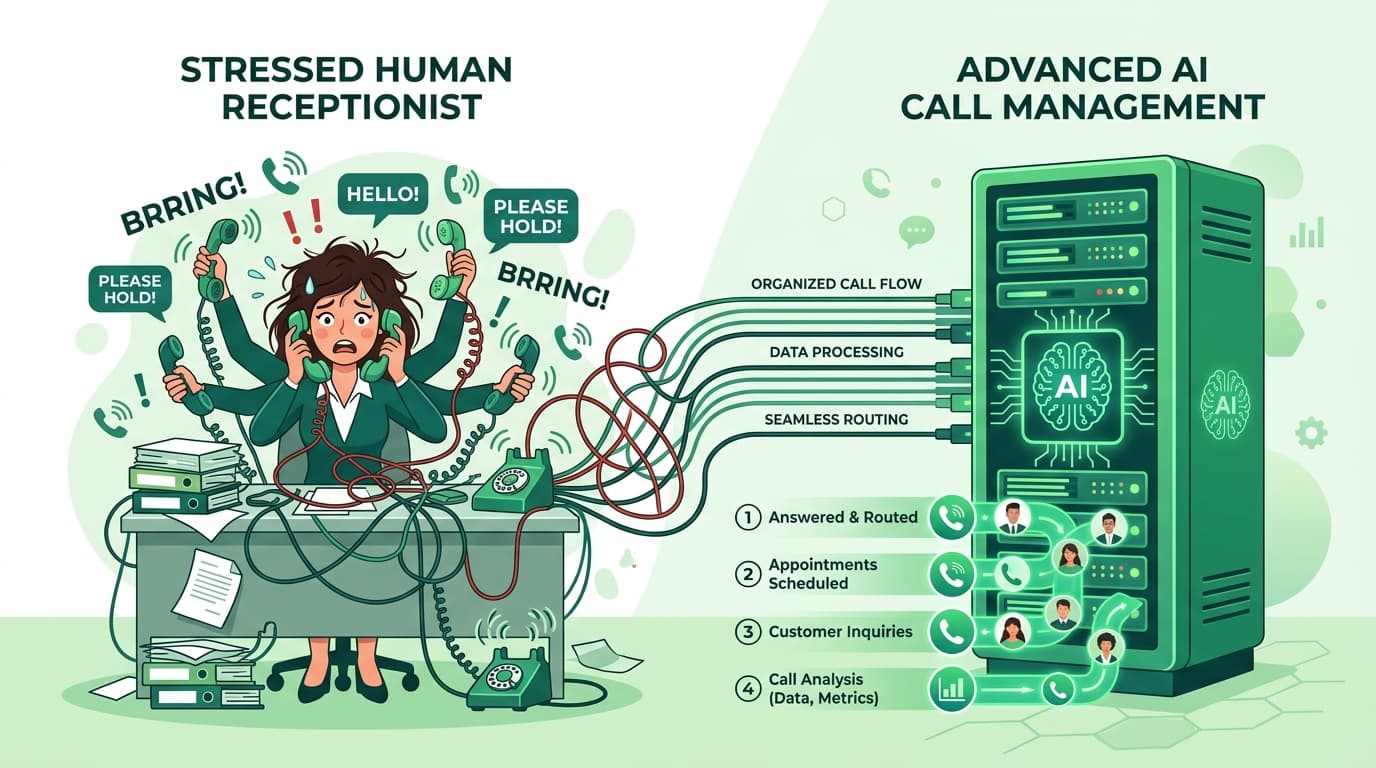
Adding more headcount is the traditional, yet highly flawed, response to the call volume problem. Hiring another receptionist does not solve overflow because a human can still only answer one call at a time; when simultaneous calls inevitably arrive, they bounce to voicemail. Furthermore, adding staff introduces massive front desk staffing costs, lengthy ramp-up times, and turnover risks, while leaving after-hours calls completely unaddressed.
Table of Contents
- The Basic Math Problem of Call Overflow
- The True Cost of Hiring a Receptionist
- After-Hours and the Limitations of Human Coverage
- The AI Solution for Scalability
- Hiring a Receptionist vs. AI Receptionist
- Frequently Asked Questions
The Basic Math Problem of Call Overflow
The underlying logic that drives most business owners to hire more front-desk staff goes something like this: "We are missing calls. Therefore, we need more people to answer the phone." But this logic fundamentally misunderstrates the nature of the call volume problem.
Call overflow is the phenomenon where incoming phone traffic exceeds the concurrent capacity of your available answering staff, resulting in calls being dropped, put on extended hold, or sent to voicemail.
Inbound phone traffic is almost never evenly distributed throughout an eight-hour workday. Instead, calls arrive in clustered surges—often first thing in the morning, during the lunch hour, or immediately following a marketing push. If two receptionists are on duty and three calls ring simultaneously, that third caller is going straight to voicemail. Even if you hire a third receptionist, a sudden spike of four calls will break the system again.
This is why lost leads continue to leak through the cracks regardless of how large your team grows. You cannot staff up enough humans to catch every unpredictable surge without paying people to sit idle during the quiet hours.
The True Cost of Hiring a Receptionist
When evaluating front desk staffing costs, many businesses mistakenly look only at the hourly wage. The reality is much more expensive. According to Glassdoor and the Bureau of Labor Statistics, the median salary for a receptionist in the US is roughly $35,000 to $40,000. However, the fully loaded cost of an employee is significantly higher.
Here is how to calculate the true fully-loaded cost of a new hire:
- Start with Base Salary: Assume $40,000 per year.
- Add Employer Payroll Taxes: Roughly 7.65% for FICA, plus state unemployment taxes.
- Factor in Benefits: Health insurance, 401(k) matching, and paid time off (PTO) typically add 20% to 30% on top of base salary.
- Include Overhead: Software licenses, telephony seats, office equipment, and training time.
- Calculate Turnover Cost: The Society for Human Resource Management (SHRM) estimates that replacing an employee costs six to nine months of their salary in recruiting and lost productivity.
When you add these factors together, a single front-desk hire actually represents a $55,000 to $65,000 annual investment. Spending that amount of money on a solution that still fails during a five-minute call surge is a remarkably inefficient use of capital.
After-Hours and the Limitations of Human Coverage
Even if a business aggressively staffs its front desk during the hours of 8 AM to 5 PM, it remains completely exposed for the remaining 15 hours of the day. Modern consumers do not respect standard business hours. When someone is stressed, dealing with a broken pipe, a legal issue, or an urgent medical inquiry, they expect an immediate response.
Concurrent call capacity is the maximum number of independent phone conversations a system can handle at exactly the same time without degradation of service.
A human's concurrent call capacity is strictly limited to one. A traditional answering service expands this slightly, but outsourced call centers are notorious for long hold times, high abandonment rates (averaging 20-30% during peak volume across the industry), and poor customer experiences due to rigid, unhelpful scripting.
The AI Solution for Scalability
Rather than throwing expensive human labor at a mathematical bottleneck, forward-thinking companies are adopting automated infrastructure. Implementing an AI voice agent for business fundamentally rewrites the rules of capacity planning.
Unlike a human, an AI does not get overwhelmed when three calls come in at once. Because it operates on cloud infrastructure through an enterprise AI voice platform, an AI voice agent has virtually unlimited concurrent call capacity. It can answer ten, fifty, or a hundred simultaneous calls instantly, on the first ring, 24 hours a day, 7 days a week, 365 days a year.
This scalability becomes even more critical as a company expands. Managing staffing schedules, sick days, and turnover for a single location is difficult; managing it across five or ten locations is a logistical nightmare. An Enterprise AI receptionist centralizes this operation. A single AI system can be deployed across dozens of localized phone numbers, automatically routing calls, answering FAQs, booking appointments, and integrating directly into your CRM, all while maintaining a consistent, flawless brand voice.
Hiring a Receptionist vs. AI Receptionist
To clearly illustrate why solving the call volume problem requires a structural shift rather than a headcount shift, let's look at a direct comparison of a human versus an AI phone system.
| Feature | Hiring an Additional Receptionist | AI Voice Agent / Enterprise AI |
|---|---|---|
| Annual Cost | $55,000 - $65,000 (Fully Loaded) | Starts under $5,000/yr based on <a href="https://roboringo.com/pricing">AI receptionist software pricing</a> |
| Concurrent Call Capacity | Exactly 1 call at a time | Unlimited simultaneous calls |
| Ramp-Up Time | 4-8 weeks of training & shadowing | Immediate deployment once configured |
| After-Hours Coverage | None (Requires separate night shift) | True 24/7/365 coverage built-in |
| Consistency | Varies by mood, stress, and fatigue | 100% consistent on every single call |
When Humans Actually Matter
It is important to note that AI is not meant to replace human empathy in highly complex or deeply emotional conversations. The goal of an AI receptionist is to handle the 80% of routine, predictable volume—scheduling, basic FAQs, routing, and triage—so that your highly trained human staff can dedicate their full, undivided attention to the 20% of calls that actually require a human touch.
By offloading the impossible task of catching every single ringing phone during a surge, you empower your existing team to do better work, reduce burnout, and ultimately provide a vastly superior customer experience.
Frequently Asked Questions
Ready to solve call volume without adding headcount?
You can't solve a scalability problem by throwing more human hours at it. With RoboRingo, you get unlimited simultaneous calls answered instantly, with zero ramp-up time and zero turnover.