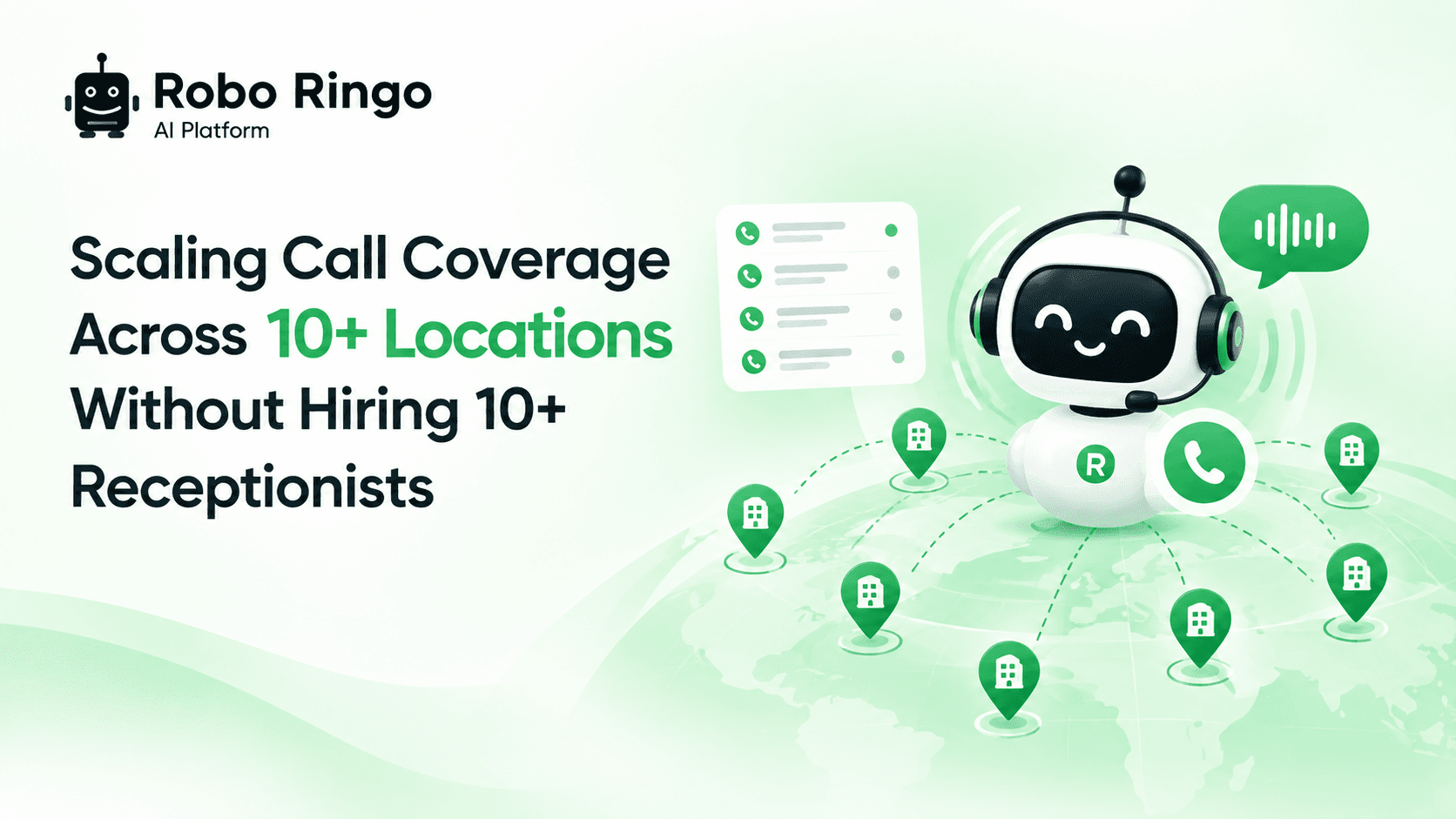
Scaling call coverage across multiple locations without proportional headcount growth requires moving away from the traditional model of a dedicated receptionist at every desk. Instead, successful multi-location businesses use a centralized AI answering service to handle all incoming calls, applying per-location routing logic to ensure every site receives consistent, 24/7 coverage. This approach unifies call data, reduces overhead, and guarantees that every customer interaction is answered instantly.
Table of Contents
- The Multilocation Staffing Dilemma
- Enter the AI-Powered Communication Platform
- How Centralized Call Coverage Works
- Why a Conversational AI Phone Agent Outperforms Traditional IVR
- The Financial Impact: Scaling Without the Overhead
- Real-World Use Cases
- Frequently Asked Questions
The Multilocation Staffing Dilemma
Centralized call coverage is the practice of handling inbound phone communication for multiple business sites from a single, unified system rather than staffing individual reception desks at each physical location. For franchises, retail chains, and medical groups, phone lines are the lifeblood of customer acquisition and service.
However, as a business scales from two to ten or fifty locations, managing call coverage becomes an exponential problem. Hiring a receptionist for every location means multiplying the average fully-loaded cost of an employee (salary, benefits, training, taxes) across every site. In the United States, the total cost to employ a full-time receptionist averages $45,000 to $55,000 annually. For a 10-location business, that represents half a million dollars solely dedicated to answering the phone.
The traditional approach breaks down in several ways. Consistency varies wildly from site to site. After-hours coverage is virtually non-existent without hiring third-party call centers that lack context. Turnover costs are immense, and when a receptionist calls in sick, the calls simply go to voicemail.
| Feature | Hiring a Receptionist Per Location | Centralized AI Call Coverage |
|---|---|---|
| Cost for 10 Locations | ~$500,000/year (fully loaded) | Fractional software cost based on volume |
| Consistency | Highly variable by location and staff | 100% consistent across all locations |
| After-Hours Coverage | None (goes to voicemail) | 24/7/365 coverage without overtime pay |
| Scalability | Slow (requires recruiting and training per site) | Instant (add a new number and location data) |
Enter the AI-Powered Communication Platform
To solve this dilemma, businesses are turning to a centralized AI-powered communication platform. This technology replaces the decentralized, human-dependent model with an intelligent routing and answering core.
Unlike older IVR systems ("Press 1 for Sales, 2 for Support"), an AI receptionist for multiple locations operates conversationally. It understands natural language, processes intent, and most importantly, dynamically adapts its responses based on the specific location the caller is trying to reach. This means a caller dialing the Chicago branch gets the Chicago address and local inventory, while a caller dialing the Dallas branch gets Dallas-specific information, all processed by the same centralized AI brain.
This architecture allows a business to maintain the localized, personal feel of a neighborhood branch while operating with the efficiency of a centralized enterprise.
How Centralized Call Coverage Works
Implementing centralized call answering for franchises or multi-site businesses follows a structured process. Here is how the transition from per-location phone lines to a centralized system typically works:
- Unifying Phone Lines: The business maintains its existing local phone numbers for each branch. However, instead of ringing directly to a physical desk phone, these numbers are routed into the centralized AI platform.
- Mapping Location Data: The platform is populated with a knowledge base containing the specific details of every location. This includes addresses, operating hours, staff directories, service availability, and specific routing rules for that branch.
- Applying Per-Location Routing Logic: When a call comes in, the system instantly identifies the dialed number and loads the corresponding location profile. The AI agent greets the caller as the specific branch (e.g., "Thank you for calling RoboRingo Dental of Austin").
- Handling and Escalation: The AI answers common questions, captures lead information, or schedules appointments using the location-specific data. If human intervention is required, the system uses per-location routing logic to transfer the call to the appropriate on-site manager or centralized support team.
- Centralized Reporting: All call data, transcripts, and analytics are fed into a single shared dashboard, allowing regional and national managers to track call volume and outcomes across the entire organization.
Why a Conversational AI Phone Agent Outperforms Traditional IVR
It is important to distinguish between a modern conversational AI phone agent and a legacy Interactive Voice Response (IVR) system. Multi-location businesses have tried IVRs for decades, often resulting in frustrated customers abandoning the call.
Location-based call routing with an AI agent does not force the caller through a maze of menus. Instead, the caller simply speaks their need: "Hi, I need to know if you have this part in stock today." The AI understands the context, knows which location was dialed, checks the relevant database, and replies conversationally.
Furthermore, an AI agent can handle concurrent calls simultaneously. A single physical location might only have two phone lines. If a third person calls, they hear a busy signal. A centralized AI platform can handle thousands of concurrent calls, ensuring no customer is ever put on hold or sent to a busy tone, regardless of how many people are calling the same location at the exact same time.
The Financial Impact: Scaling Without the Overhead
The financial math of multi-location call coverage is undeniable. Consider a rapidly expanding franchise opening five new locations this year. In a traditional model, the franchise must recruit, hire, train, and manage five new receptionists. This introduces immediate friction to scaling. It takes weeks to hire and train staff, and the cost structure increases linearly with every new location.
With a centralized AI receptionist for multiple locations, the cost structure shifts from linear headcount to scalable software usage. Opening a new location simply means provisioning a new local phone number, uploading the new location's data to the AI's knowledge base, and turning the system on. The AI is instantly "trained" on the new location's details. This allows the business to scale call handling without hiring, decoupling operational growth from administrative headcount.
Real-World Use Cases
Different industries leverage centralized phone answering for franchises and multi-site operations to solve specific pain points.
Retail Chains
Retail stores often suffer from front-line staff having to split their attention between in-store customers and a ringing phone. An AI agent handles inventory checks, store hours, and return policy questions, allowing retail staff to focus entirely on the customer standing in front of them.
Medical and Dental Groups
Multi-location clinics use centralized AI to manage appointment scheduling and patient intake. The AI can route calls across locations based on appointment availability. If the downtown clinic is fully booked, the AI can seamlessly offer the caller an open slot at the suburban location, maximizing revenue and patient satisfaction.
Franchises and Real Estate
For franchise networks and regional real estate offices, maintaining brand consistency is paramount. A centralized system ensures that every call is answered with the exact same professional greeting and that leads are captured and routed into the central CRM immediately, preventing valuable opportunities from slipping through the cracks.
Frequently Asked Questions
Ready to cover every location without hiring for every location?
Scaling your business should not mean multiplying your administrative overhead. One platform handles call coverage, intelligent per-location routing, and unified reporting across every single site.
Ready to see RoboRingo in action?
Handle calls, SMS, and WhatsApp with AI agents that work 24/7 — set up in minutes, not months.
Explore RoboRingo →