If you've spent any time researching call automation, you've probably noticed the terms "AI receptionist" and "AI voice agent platform" get used almost interchangeably. They shouldn't be. One is a job. The other is the machine capable of doing that job, and a hundred others like it.
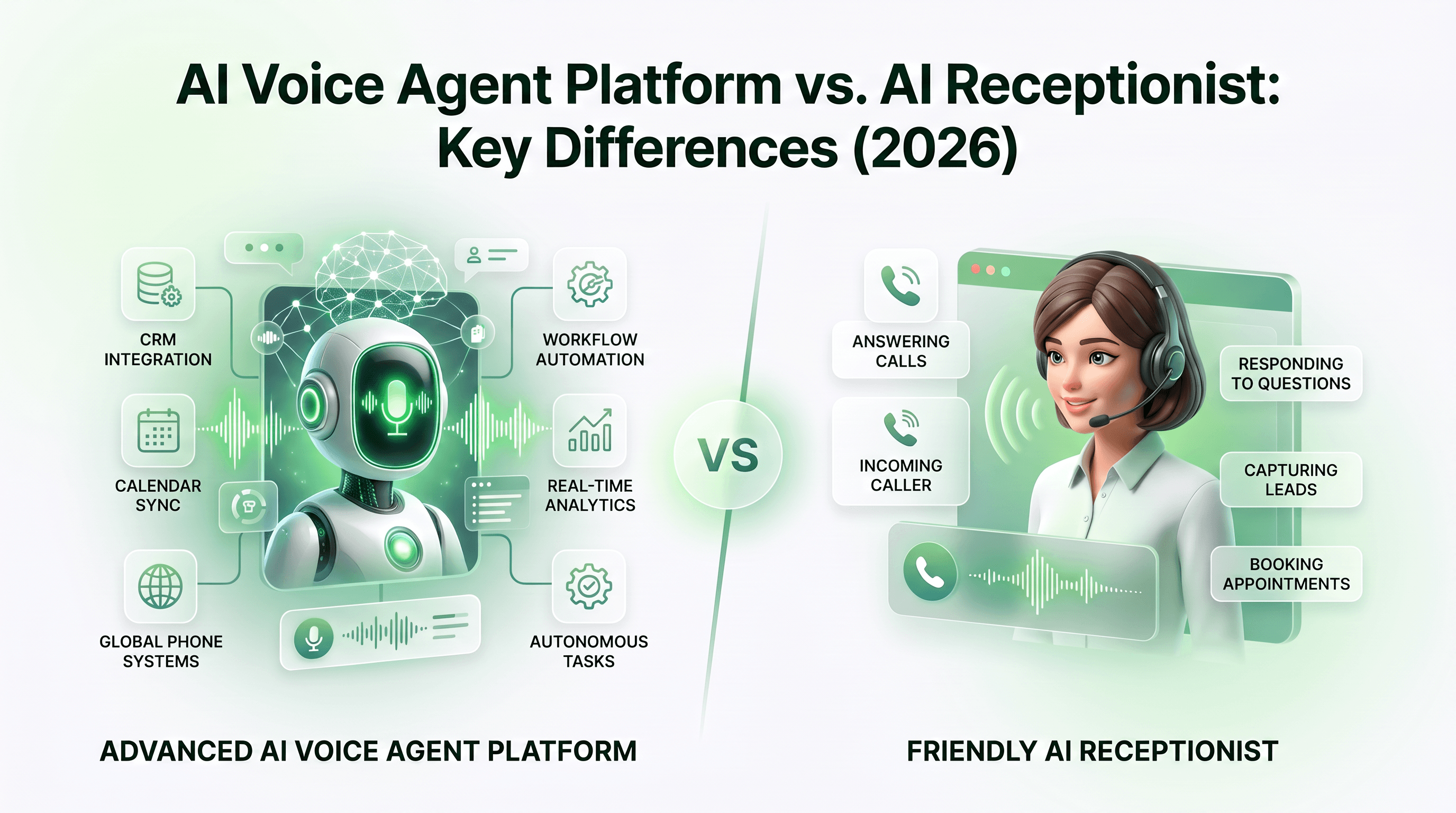
Here's the short version, if that's all you came for: an AI receptionist is a narrow, purpose-built tool that answers calls, takes messages, and routes them, similar to what a human receptionist does. An AI voice agent platform is broader infrastructure — the underlying system that can be configured to act as a receptionist, a scheduling assistant, a support agent, or several of these at once, often across multiple phone numbers and departments. Every AI receptionist runs on some kind of voice agent platform. Not every voice agent platform is trying to be a receptionist.
That distinction matters more than it sounds like it should, because it changes what you're actually evaluating when you compare vendors.
What is an AI receptionist?
An AI receptionist answers incoming calls, greets the caller, understands what they need, and does one of three things: answers a common question, takes a message, or transfers the call to the right person. Good ones sound natural, work 24/7, and integrate with your calendar or CRM so a booked appointment or a captured lead doesn't just sit in a transcript nobody reads.
Most AI receptionist products are built for a specific job and a specific volume of calls: a dental office, a law firm's intake line, a home services company fielding "are you open Saturday" calls. They're tuned for a narrow set of intents, and that narrowness is the point. It's why they can be set up in an afternoon.
What is an AI voice agent platform?
An AI voice agent platform is the infrastructure layer underneath. It handles real-time speech recognition, natural language understanding, text-to-speech, call routing, and the logic that decides what the agent says next — and it's built to be configured, not just switched on. Enterprises use these platforms to run dozens of different call flows: a receptionist for the front line, a specialized agent for billing questions, another for scheduling, another for after-hours triage, sometimes across different brands or business units, all sharing the same underlying voice infrastructure and reporting layer.
RoboRingo is built this way. Under the hood it's LiveKit for real-time audio, Deepgram for speech recognition, and OpenAI for the language model doing the actual reasoning. That's the same category of stack you'd find at Retell AI or Bland AI, not the category you'd find at a single-purpose answering app.
So what does RoboRingo actually do?
RoboRingo is an enterprise AI receptionist and AI voice agent platform. In practice, that means it can run as a straightforward front-line receptionist for a single business, or scale into a full multi-flow voice agent system: routing calls by intent, taking structured messages, transcribing every conversation in real time, and handing off to a human with full context when a call needs one. Teams use it both ways, depending on where they are — which is really the point of this whole article: you shouldn't have to pick a new vendor the moment you outgrow "receptionist."
The core differences
| Feature | AI Receptionist | AI Voice Agent Platform |
|---|---|---|
| Scope | One job: answer, screen, route | Many call flows, configurable per use case |
| Setup | Fast, template-driven | Slower, more configuration up front |
| Customization | Limited, mostly scripts and greetings | Deep — custom logic, integrations, multi-agent workflows |
| Typical buyer | Small business, single office | Enterprise, multi-location, or teams building their own call products |
| Scaling | Add more minutes | Add more agents, workflows, and phone numbers on shared infrastructure, optimizing <a href="https://roboringo.com/pricing">AI voice agent pricing</a> |
| Compliance depth | Varies, often basic | Usually built for HIPAA, SOC 2, and similar requirements |
Which one does your business actually need?
Honestly, this comes down to how many different "jobs" your phone lines need to do, and how much that's going to change over the next year. As an AI communication company, we see businesses constantly underestimate their future needs.
An AI receptionist is probably enough if
- You have one main line and a handful of call types (booking, FAQs, message-taking)
- You're a single location or a small, focused team
- You want something live in days, not weeks
- Your call volume is steady and doesn't need custom routing logic
You need a full voice agent platform if
- You're running call automation across multiple departments, brands, or locations
- You need calls to trigger real actions in other systems (CRM updates, ticket creation, order lookups), not just log a transcript
- You operate in a regulated industry and need audit-ready compliance, not just "we say we're secure"
- You expect to keep adding new call flows over time and don't want to bolt on a new vendor every time you do
- Your IT or engineering team wants control over the underlying model, routing logic, or integrations, instead of working inside someone else's template
Where people get confused
A lot of vendors blur this line on purpose. It's easier to market "AI receptionist" because everyone already understands what a receptionist does. So companies that are really selling voice agent infrastructure will still call themselves an "AI receptionist" on their homepage, because that's the term people search for.
That's not necessarily dishonest, but it does mean you can't shop by category label alone. A better question than "is this an AI receptionist or a voice agent platform" is: can this system grow with me without a rebuild? If the answer requires switching vendors the moment you add a second use case, you bought a receptionist wearing a platform's marketing.
What to actually check before you commit
- Ask what's under the hood. Vendors running on established infrastructure (Deepgram, LiveKit, well-documented LLM providers) tend to be more transparent about latency, accuracy, and uptime than ones with proprietary black-box stacks.
- Ask how a second use case gets added. If it's "talk to sales, we'll scope a new build," that's a receptionist. If it's "configure a new flow in the dashboard," that's a platform.
- Ask about compliance in specifics, not adjectives. "Secure" isn't an answer. SOC 2 Type II, HIPAA BAAs, and where call data is stored and for how long, are answers.
- Test the handoff, not just the greeting. Every demo sounds good in the first ten seconds. Ask what happens when the caller says something the script didn't anticipate.
The bottom line
If you just need your phone answered well, an AI receptionist will get you there faster and cheaper. If you're trying to build call automation into how your business actually operates — across departments, systems, and time — you want the platform underneath it, not just the receptionist sitting on top.
That's the gap RoboRingo is built to close: it starts as an AI receptionist you can set up quickly, but it's running on real voice agent infrastructure underneath, so it doesn't need to be replaced the moment your call handling needs get more complex.
FAQs
Ready to see RoboRingo in action?
Handle calls, SMS, and WhatsApp with AI agents that work 24/7 — set up in minutes, not months.
Explore RoboRingo →