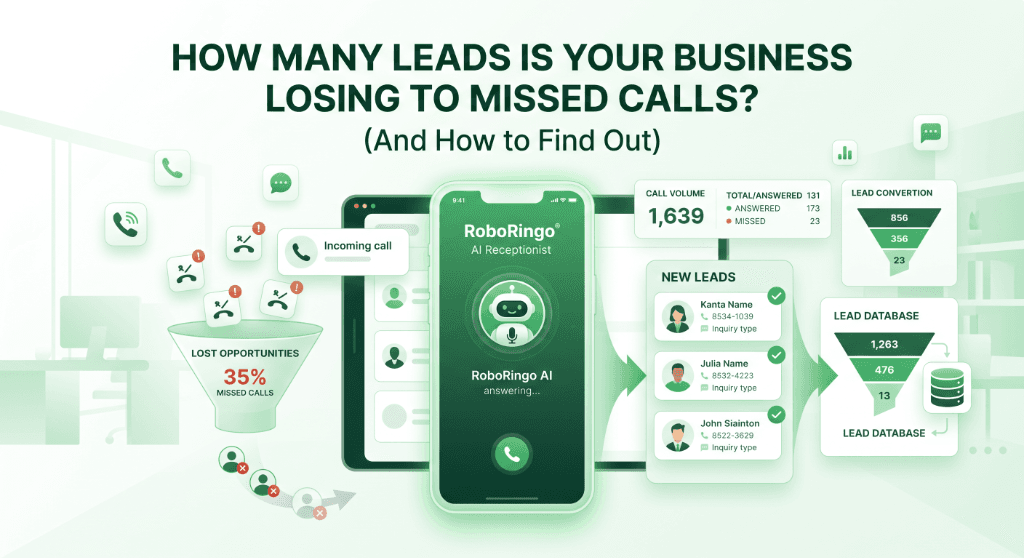
Every time your business phone rings and goes unanswered, you aren't just missing a conversation—you're likely handing a qualified lead directly to your competitor. Research shows that roughly 62% of business calls go unanswered, and a staggering 85% of people whose calls aren't answered won't call back. Understanding how these missed calls translate into lost leads is the first step to reclaiming that hidden revenue.
Table of Contents
- The True Cost of a Missed Call
- Why Voicemail Is No Longer Enough
- How to Calculate Your Lost Revenue
- The Financial Impact Across Industries
- How to Fix It: AI Receptionists and Automated Responses
- Frequently Asked Questions
The True Cost of a Missed Call
The phrase missed calls lost leads is more than just an industry buzzword; it's a measurable leak in your sales funnel. Most business owners severely underestimate their missed call rate—the percentage of inbound calls that are abandoned before they can be answered. While many owners believe their teams are catching 80-90% of calls, call tracking audits frequently reveal that businesses only answer 38% to 45% of incoming calls live.
A missed call has a short shelf life. When a potential customer reaches out, they are highly motivated. If they don't get an answer, that motivation drops rapidly. Data indicates that a lead's interest wanes within just 10 minutes of a missed connection. In highly competitive sectors like home services, legal, or medical clinics, a caller who doesn't get a live answer will simply proceed down the Google search results to the next provider.
This phenomenon doesn't just happen during your busiest hours. A significant portion of these lost leads are contacting you outside of standard business hours. When someone has a burst pipe at 9:00 PM, they aren't going to wait until 8:00 AM the next day to get a response. They will call every number they can find until a human—or a highly capable virtual AI receptionist—answers the phone. Every time you fail to answer, you are actively subsidizing your competitors' growth.
Furthermore, the cost of a missed call goes beyond the immediate loss of a single transaction. You are also losing the potential lifetime value of that customer, their repeat business, and their word-of-mouth referrals. The compounded cost of these missed opportunities can be devastating for a small business looking to scale.
Why Voicemail Is No Longer Enough
For decades, businesses relied on voicemail as their safety net. Today, voicemail is a black hole for lead generation. Relying on voicemail to capture leads in the modern era is akin to using a fax machine for instant communication—it simply doesn't align with consumer expectations.
Consider the modern consumer's mindset: they want immediate gratification and quick answers. According to studies from Invoca, up to 80% of callers will hang up immediately upon hearing a voicemail greeting. They don't want to play phone tag; they want a solution to their problem right now. If your strategy for handling overflow calls relies entirely on a pre-recorded message, you are effectively turning away four out of every five potential customers who try to reach you when you're busy.
Even when a caller does leave a voicemail, the friction of calling them back often results in failure. The lead may have already called a competitor, or they might simply be unavailable when you attempt to return their call. This constant back-and-forth drains your staff's time and resources, leading to frustration on both ends. In a world where instant communication is the norm, forcing a customer to wait for a callback sends a subtle but damaging message: your time is more valuable than theirs.
Traditional Interactive Voice Response (IVR) systems are equally flawed. These systems, characterized by long menus of "Press 1 for Sales, Press 2 for Support," often frustrate callers to the point of abandonment before they ever reach a human. A call abandonment rate is the percentage of callers who hang up before their call is answered or resolved. High abandonment rates are a direct symptom of poor call handling infrastructure, whether that's an endless ring tone or a confusing IVR maze.
How to Calculate Your Lost Revenue
To understand how much revenue do missed calls cost your specific business, you need to look past abstract percentages and do the math based on your own metrics. Abstract statistics are helpful for framing the problem, but nothing drives action quite like seeing your own potential revenue slipping away. Here is a step-by-step process to calculate your lost opportunity cost:
- Audit Your Call Logs: Review your phone system or carrier records for the last 30 days to find the exact number of inbound calls that were abandoned or went to voicemail. Make sure to include after-hours and weekend calls in this audit.
- Determine Your Average Daily Missed Calls: Divide that 30-day total by 30 to get your daily average. For many small businesses, this number sits surprisingly high, often between 5 and 15 calls a day.
- Apply Your Conversion Rate: Estimate what percentage of inbound phone calls typically turn into paying customers. (A conservative baseline is often 20-30%, though highly motivated callers in certain industries can convert at much higher rates).
- Multiply by Customer Lifetime Value (CLV): Multiply the number of lost customers by the average revenue a single customer brings in over their lifetime with your business.
Example: If you miss 5 calls a day, your conversion rate is 20%, and your CLV is $1,000, you are losing 1 customer a day. Over a standard 250-day working year, that equates to $250,000 in lost top-line revenue—all from calls you simply didn't answer. For a business with higher ticket items, like a roofing company or a private medical practice, that number can easily eclipse a million dollars annually.
This calculation often serves as a wake-up call for business owners. When you realize that investing in a robust call answering service for businesses costs a tiny fraction of the revenue you're currently losing, the decision to upgrade your phone strategy becomes incredibly straightforward.
The Financial Impact Across Industries
While the underlying mathematics of lost revenue apply broadly, the specific impact varies wildly depending on your industry. Let's explore how missed calls affect different sectors:
Home Services (HVAC, Plumbing, Electrical)
In the home services industry, urgency is the primary driver of consumer behavior. When an AC unit breaks in the middle of a heatwave, the customer isn't browsing for the best price—they are looking for the fastest response. A single missed call can easily represent a lost job worth anywhere from $300 for a simple repair to over $10,000 for a full system replacement. Furthermore, a satisfied emergency customer often becomes a lifelong client, compounding the initial loss.
Healthcare and Medical Practices
Medical practices deal with a different kind of urgency. New patients seeking specialized care, such as dental implants or elective surgeries, often require a high-touch onboarding process. A missed call here isn't just a lost appointment; it's a breakdown in patient trust. The lifetime value of a medical patient can be extraordinarily high, meaning that even a small handful of missed calls per week can severely stunt a clinic's growth.
Legal and Professional Services
For law firms, particularly those dealing with personal injury or criminal defense, the stakes of a single missed call are monumental. A lead in these fields is often highly distressed and looking for immediate reassurance. If they reach a voicemail, they will undoubtedly call the next lawyer on their list. A single lost retainer can represent tens of thousands of dollars in revenue.
| Industry | Average Value of a Missed Call | Primary Reason for Call Abandonment | Ideal Solution |
|---|---|---|---|
| Home Services | $300 - $10,000 | Lack of immediate response during emergencies | 24/7 AI Receptionist or Live Answering |
| Medical Practices | $500 - $5,000+ | Frustration with complex IVR systems | Conversational AI for simple scheduling |
| Legal Services | $2,000 - $50,000+ | Need for immediate human empathy/reassurance | Missed-Call Text-Back for rapid follow-up |
| Retail / E-commerce | $50 - $200 | Long hold times for simple inquiries | AI Voice Agent for order status/FAQs |
How to Fix It: AI Receptionists and Automated Responses
Recognizing the problem is only half the battle. The traditional solution—hiring more front-desk staff—is often cost-prohibitive when you look at virtual receptionist pricing, and doesn't solve the problem of after-hours calls or weekend inquiries. A human receptionist can only handle one call at a time, meaning that during peak hours, overflow calls will still slip through the cracks. This is where modern call automation through an AI business phone system steps in to bridge the gap.
The AI Receptionist for Small Business
An AI receptionist is a conversational voice agent capable of understanding natural language, answering FAQs, and routing calls 24/7. Unlike older, frustrating IVR systems that force callers through endless numbered menus, a modern AI phone agent can hold a natural, human-like conversation. It can answer common questions, qualify the lead, and even book an appointment directly onto your calendar.
The beauty of an AI receptionist is its scalability. Whether you receive five calls simultaneously or fifty, the AI can handle each one with zero hold time. This ensures a consistent, high-quality experience for every caller, regardless of when they reach out or how busy your human staff might be. Furthermore, AI agents can be trained on your specific business data, ensuring they provide accurate, on-brand information.
Missed-Call Text-Back Automation
If a fully conversational voice agent isn't the right fit for your current operations, another incredibly powerful tool is missed-call text-back technology. This system automatically detects when an incoming call from a mobile number is missed—whether due to a busy signal, a direct send to voicemail, or ringing out—and immediately dispatches a customized SMS to the caller.
For example, the automated text might say: "Hi, this is RoboRingo! We're on the other line right now, but how can we help you today?" This instant engagement catches the lead before they have a chance to call the next business on their list, transitioning the conversation to a convenient, asynchronous text medium. It acknowledges the customer's effort to reach you and provides an immediate avenue for them to state their needs.
Implementing a missed-call text-back strategy is often one of the highest ROI actions a small business can take. It requires minimal setup, operates quietly in the background, and can dramatically increase your lead capture rate without requiring additional staff.
Frequently Asked Questions
Ready to stop losing leads to missed calls?
Every unanswered call is a missed opportunity for growth. With RoboRingo, you can ensure that every call is answered 24/7, capturing leads the moment they show interest with our conversational AI agents and automated text-back systems.