It's 7:42 on a Tuesday evening. A homeowner's kitchen has an inch of water on the floor, and she's calling the third plumber on her list. The first two went to voicemail. The third one picks up on the second ring: "Thanks for calling Ridgeway Plumbing, I'm the virtual assistant. Is this an emergency?" She says yes, gives her address, and gets a callback from the on-call technician within minutes. She never asks whether she's talking to a person. She just wanted someone to answer.
Now a different call. A man phones a dental office to reschedule his mother's appointment. Halfway through, he stops and asks, "Wait, am I talking to a real person?" The assistant answers plainly that it's the office's virtual assistant and offers to transfer him to the front desk. He says, "No, that's fine, just move it to Thursday." Done in under a minute.
And a third, where things go less smoothly. A caller interrupts mid-sentence, changes his mind twice, then asks something the system was never set up for. There's a two-second pause, then a generic reply. He hangs up and calls the office's mobile number instead.
*(These are illustrative scenarios, not case studies from specific customers.)*
Three calls, three very different outcomes, and in none of them was the voice the deciding factor. What mattered was whether the caller got help quickly, whether they were told the truth, and whether a human was within reach. That's the real answer to the question in this blog's title.
Sometimes, yes, and increasingly no, but that's the wrong question to build your strategy around. In one Twilio study, 90% of consumers failed to correctly identify AI-generated voice clips, so on short, routine exchanges many callers won't notice. On a live call, though, callers pick up on delays, stiff phrasing, and awkward handling of off-script questions. And the legal and trust picture points the same direction regardless of how good the voice sounds: tell callers up front that they're speaking with an AI assistant, and make it easy to reach a person.
If you're weighing an AI receptionist for your business, this is probably the question sitting in the back of your mind. Below is what's actually known, what isn't, and how to set things up so the answer doesn't matter.
Key Takeaways
- Voice quality has improved to the point that many people can't reliably tell. Twilio's research found 90% of consumers misidentified AI-generated voice clips.
- There's no published, neutral number for live-call detection. Clip tests aren't the same as a real two-way conversation, so treat any vendor's "nobody can tell" claim with skepticism.
- The tells are conversational, not vocal: response delay, trouble being interrupted, repeated word-for-word answers, and odd handling of unexpected questions.
- Disclosure is becoming the norm and, in places, the law. No single U.S. federal rule requires it, but the FCC treats AI voices as "artificial" under the TCPA, Utah requires an honest answer when asked, and the EU AI Act adds transparency duties.
- Businesses that disclose clearly, with an easy path to a human, report no satisfaction penalty. Passing AI off as a person is the riskier move.
Can Callers Actually Tell?
The honest answer depends on what you're measuring.
In audio-clip tests, most people can't. Twilio's research found that 90% of consumers failed to correctly identify AI-generated voice clips. Modern speech synthesis handles pacing, intonation, and filler sounds far better than the robotic IVR voices people still associate with "phone robots."
On a live call, it's less clear-cut. As one industry write-up put it, no neutral study currently publishes how often callers detect an AI voice agent on a real call, and it's easy to overstate the number by citing general familiarity instead. (For context, Pew found 49% of U.S. adults had used an AI chatbot as of a February 2026 survey.) Familiarity with AI isn't the same as being able to spot it mid-conversation.
What people do notice on live calls tends to be behavior, not voice quality:
- Latency. A noticeable pause before every response is the most common giveaway.
- Interruptions. Some systems stumble when a caller talks over them.
- Repetition. Ask the same thing twice in different words and get an identical answer, and the illusion breaks.
- Off-script questions. Unusual requests are where scripted or poorly configured systems fall back on generic replies.
The practical takeaway: a well-configured system will pass for a human on routine calls (hours, directions, booking a slot). A poorly configured one won't, no matter how natural the voice sounds.
Does the Law Require You to Say It's an AI?
There's no single national rule, but the direction of travel is clear. As of September 2026:
- U.S. federal: No general federal law says "you must announce your bot." But in February 2024 the FCC ruled that AI-generated voices count as artificial voices under the TCPA, which brings older consent and caller-identification requirements into play for AI calling.
- Utah: Utah's S.B. 226 (effective May 7, 2025) requires a business using generative AI in a consumer transaction to disclose that the person is interacting with AI if they clearly ask.
- Other states and the EU: Several states have added disclosure language to consumer protection laws, and the EU AI Act's transparency obligations apply to AI systems that interact with people.
Liability doesn't disappear either. In the 2024 Air Canada chatbot case, the company was held responsible for what its AI told a customer.
This is a fast-moving area and rules differ by state, country, and industry (healthcare and financial services carry extra obligations), so confirm the requirements for your jurisdiction with legal counsel before deploying. Nothing here is legal advice.
Why Disclosure Is Also Just Good Business
Beyond compliance, there's a plain trust argument. In one industry roundup, 72% of U.S. consumers said they prefer to know when they're talking to an AI. Whatever the exact figure, the pattern matches what most operators see: callers rarely mind an AI that's fast, accurate, and upfront, and they mind a great deal when they feel deceived.
The same roundup notes that brands that disclose clearly, and make it easy to reach a human, see no customer-satisfaction penalty, while those that try to pass AI off as human take a trust hit when it's discovered.
There's also a counterintuitive upside. Callers are often relieved to reach an AI rather than a voicemail box. Most callers who hit voicemail simply hang up and try someone else, so an immediate, helpful answer, even from an assistant that says it's an assistant, beats silence. And every missed call carries a real price tag.
How to Set Up an AI Receptionist So the Question Doesn't Matter
Rather than trying to make callers not notice, design the experience so noticing is harmless:
- Disclose in the greeting. A short line like "Thanks for calling [Business], I'm the virtual assistant" sets expectations in the first few seconds.
- Answer honestly when asked. If a caller asks "Am I talking to a real person?", the answer should be truthful, every time.
- Offer an easy path to a human. Callers who need judgment, empathy, or an exception should be routed to staff quickly, not trapped in a loop.
- Tune for latency and interruptions. Test the system with real, messy calls (people who talk over it, change their minds, ask odd questions) before going live.
- Review transcripts. Real call transcripts show where the system stumbles, so you can tighten flows over time.
- Keep humans where they matter. The goal is to stop missed calls and overflow, not to remove people from conversations that need them.
How RoboRingo Handles This
RoboRingo lets you configure the AI's greeting and persona, so you decide how it introduces itself, including stating that it's a virtual assistant. Smart routing and ring groups send callers who need a person to the right team member, and every call is transcribed in real time with a summary, so you can review how conversations actually go and refine them.
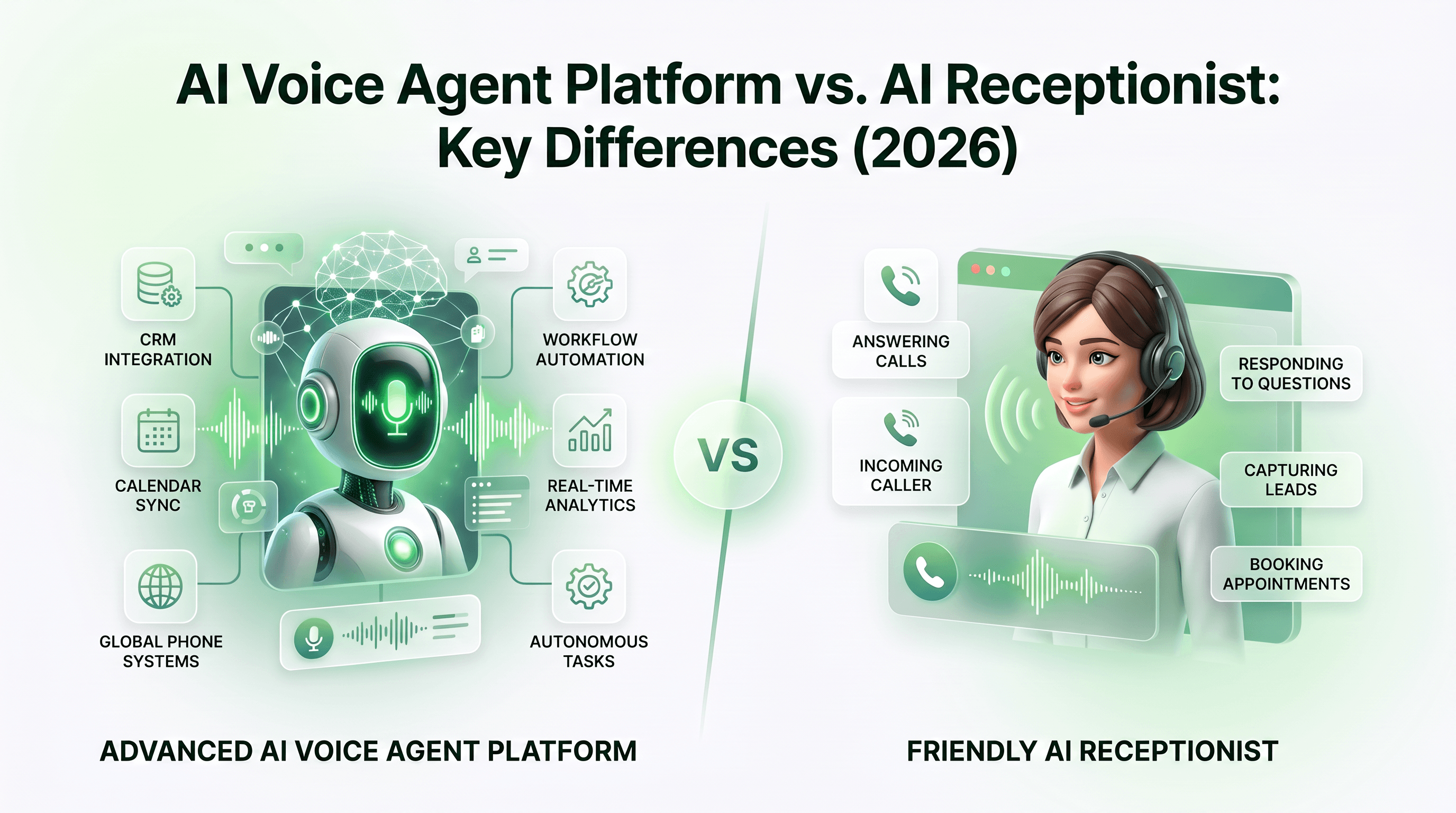
An honest note on naturalness: RoboRingo's average AI response time is under three seconds, which is competitive for managed platforms but not the sub-second speed of the most latency-optimized custom builds. In practice, we'd rather you set expectations with a clear greeting than rely on callers not noticing. If you're comparing options, this breakdown of AI voice agent platforms versus AI receptionists explains why purpose-built receptionist tools trade some raw configurability for faster, more reliable setup, and this buyer's checklist covers what to test in a demo, including latency and escalation behavior.
Frequently Asked Questions
Ready to see RoboRingo in action?
Handle calls, SMS, and WhatsApp with AI agents that work 24/7 — set up in minutes, not months.
Explore RoboRingo →