Imagine three callers hitting the same business's phone line in one week. None of these are real customer stories, but the pattern will feel familiar to anyone who has sat through a "press 1 for..." menu.
Caller 1 wants to know if a package arrived. She gets "For billing, press 1. For appointments, press 2. For all other inquiries, press 3." None of the options fit. She presses 3, waits on hold, and hangs up before anyone picks up.
Caller 2 picks "press 2 for support," gets transferred, has to repeat his issue, gets transferred again, and by the third hop he's already decided to just email instead.
Caller 3 calls at 8:15 p.m. and hears "Our office is currently closed. Please call back during business hours." No option to leave a message, no callback, nothing. He calls a competitor instead.
Three calls, three menu-tree failures, and none of them were unusual. This is the ordinary experience of a legacy IVR system, and it's exactly why the question in this post's title matters: does replacing that menu with an AI receptionist actually fix it, or is that just a newer name for the same problem?
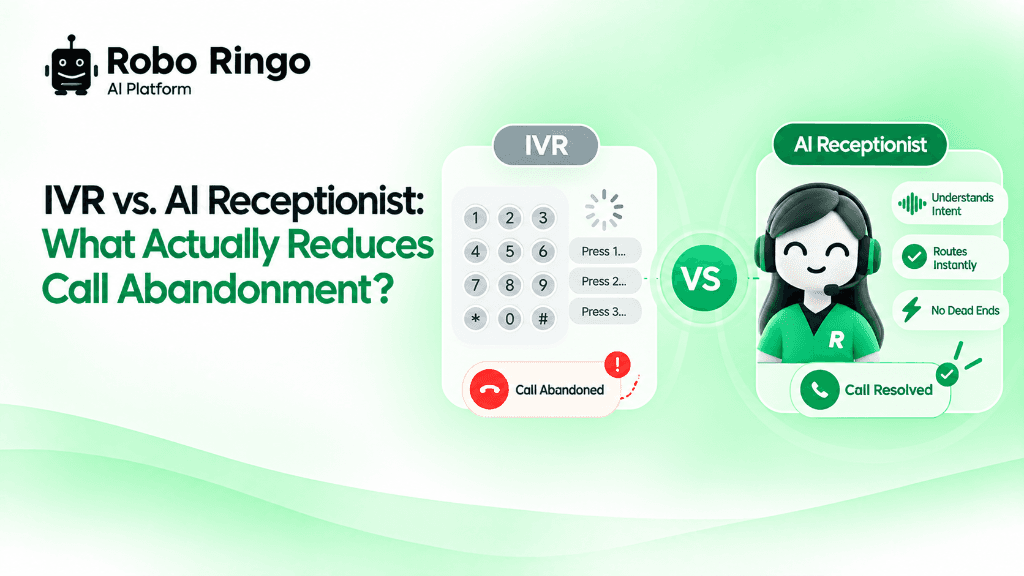
Short answer: yes, for most call types, and the data on this is fairly consistent. Legacy multi-level IVR menus are associated with abandonment rates commonly cited between 20% and 35%, while businesses that replace IVR with a conversational AI receptionist typically report abandonment dropping to somewhere in the 5–10% range. AI isn't automatically better for every call type, though, and there are still situations where a simple menu is the right tool. The rest of this post covers both sides honestly.
Key Takeaways
- Legacy IVR menus are commonly associated with 20–35% call abandonment, largely driven by rigid decision trees, misrouting, and long hold times.
- 60% of callers won't wait on hold more than a minute, and a large share of people who abandon a call never try again.
- AI receptionists that replace legacy IVR typically bring abandonment down to roughly 5–10%, according to industry benchmarking, though the exact number depends heavily on call complexity and how well the system is configured.
- AI performs best on complex, multi-intent, or ambiguous calls. It doesn't automatically beat a simple, well-designed menu for very low call volumes or narrow, deterministic routing needs.
- Misrouted calls are expensive, not just annoying. A call that gets transferred multiple times can cost several times more to resolve than one handled correctly the first time.
- The real decision isn't "IVR or AI" as a blanket choice. It's understanding which of your call types are driving abandonment and fixing those first.
Why Legacy IVR Drives Callers to Hang Up
Multi-level IVR menus were built for a different era of calling, and the structural problems haven't changed even as the technology around them has: every caller has to fit into a predefined branch, whether or not their actual question matches one of the options. When it doesn't, they either guess, get misrouted, or just hang up. Industry benchmarking puts abandonment on these multi-level phone trees commonly between 20% and 35%, with long menus cited repeatedly as the top reason people give up before reaching a human.
The wait itself is a large part of it. Most sources converge on the same finding: roughly 60% of callers won't wait on hold longer than a minute, and during peak call windows, abandonment on legacy systems routinely climbs well past 20%. Once someone hangs up, the odds they try again aren't great, either. Estimates range from roughly a third to well over half of abandoned callers never calling back at all, which means every abandoned call is a real chance the business simply never hears from that person again.
Misrouting compounds the cost. When a caller picks the wrong branch, gets transferred, has to repeat themselves, and gets transferred again, each hop adds handle time and frustration, and a call resolved after three transfers can cost several times more than one resolved cleanly on the first attempt. The revenue math behind a single missed or mishandled call applies just as directly to a call that technically got "answered" by a menu tree but never actually reached anyone useful.
What Changes With an AI Receptionist
A conversational AI receptionist replaces the decision tree with a caller simply saying what they need, in plain language, and the system routing or resolving it from there instead of forcing them through a fixed set of button presses.
Industry benchmarking on IVR-to-AI transitions reports abandonment dropping from roughly 35% down to somewhere in the 5–10% range after the switch, typically within the first 90 days, alongside meaningful drops in average handle time. The mechanism is straightforward: a caller who says "I need to reschedule an appointment for Thursday" gets routed correctly the first time, instead of guessing between "press 2 for scheduling" and "press 4 for all other requests."
It's worth being precise about where the gains are biggest, rather than treating this as a universal win. AI receptionists show the clearest improvement on complex or multi-intent calls, the ones a rigid menu handles worst. On very high-volume, deterministic routing tasks, the gap narrows, and in some analyses a well-built AI system underperforms a simple, fast menu for calls that genuinely only need a single, predictable route.
Where a Simple IVR Menu Still Makes Sense
This is where honesty matters more than a clean sales pitch. A basic menu can still be the right call when:
- Call volume is genuinely low (well under 50 calls a day), where the economics of a conversational AI system may not justify the setup.
- The menu is truly simple — two or three options, no self-service actions needed, and callers rarely land in the wrong branch.
- Regulatory or compliance requirements call for deterministic, auditable routing. Some healthcare and legal contexts fall into this category, and the same caution applies here that applies to any AI-assisted call handling in a regulated setting — confirm what your specific compliance obligations require before assuming a conversational system is the right fit.
Outside of those cases, the calculation tends to favor a conversational system: if tier-1 questions make up a large share of your calls, if wait times consistently run past a minute, if you want 24/7 coverage without staffing for it, or if your callers speak more than one language, a menu tree is working against you more than it's helping.
A Quick Way to Tell Which Situation You're In
| Signal | Favors a simple IVR menu | Favors an AI receptionist |
|---|---|---|
| Call volume | Under ~50 calls/day | Higher, or growing |
| Call complexity | 2–3 clear, non-overlapping routes | Multiple intents, varied requests |
| Wait times | Consistently short | Regularly exceeding 60 seconds |
| Hours | Business hours only, low after-hours demand | 24/7 coverage matters |
| Languages | Single language, consistently | Multiple languages among callers |
| Compliance need | Deterministic, auditable routing required | Standard routing, flexibility valued |
How to Evaluate the Switch for Your Business
Before replacing a menu system, get specific rather than assuming the industry averages apply directly to you:
- Pull your actual abandonment rate, not an industry benchmark, if your current phone system can report it.
- Identify which call types are driving abandonment. Complex or ambiguous requests are usually the bulk of it; simple, single-purpose calls usually aren't.
- Check your after-hours volume. A menu that just says "call back later" with no fallback is often the single biggest source of preventable abandonment.
- Confirm what a new system does with misrouted or ambiguous calls, not just the calls that go smoothly in a demo. What happens when the system genuinely can't answer or route correctly is one of the most important things to test before committing.
- Weigh compliance requirements honestly if you're in a regulated industry, rather than assuming every AI receptionist handles that the same way.
How RoboRingo Fits
RoboRingo replaces the decision-tree structure with natural, intent-based routing: a caller says what they need, and smart routing sends the call to the right team, department, or ring group, which can reach whoever is actually available in parallel or in sequence rather than a single extension. Every call is transcribed in real time with a summary, so misrouted or escalated calls carry context instead of forcing the caller to repeat themselves. Business hours and after-hours behavior are configurable, which closes the specific gap that Caller 3 in the opening scenario ran into: a dead end after hours with no path forward.
Worth stating plainly: the abandonment-reduction figures cited in this post are industry benchmarks from IVR-to-AI transitions broadly, not a guaranteed number for every RoboRingo deployment. Your actual results depend on your current call mix, your configuration, and how well your escalation rules are set up. If a specific abandonment-reduction target matters for your business case, that's worth discussing directly during onboarding rather than assuming an industry average will apply exactly to your calls.
Frequently Asked Questions
Ready to see RoboRingo in action?
Handle calls, SMS, and WhatsApp with AI agents that work 24/7 — set up in minutes, not months.
Explore RoboRingo →