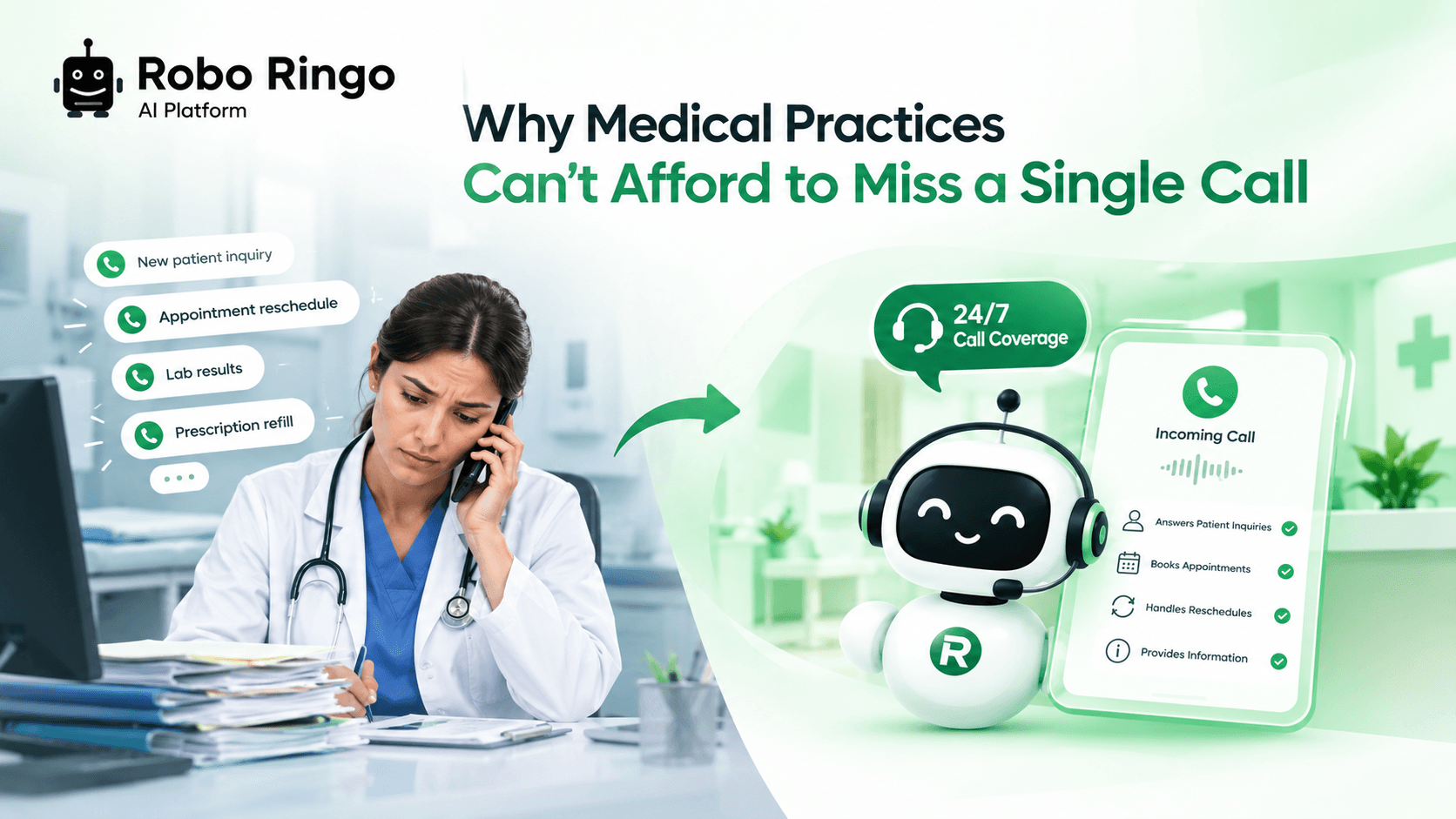
For most businesses, a missed call means a missed sale. For a medical practice, it can mean a missed diagnosis follow-up, a patient who needed a same-day appointment and went to urgent care instead, or a new patient who called a competitor within minutes. Small healthcare practices miss roughly 1 in 4 inbound calls, and most of those patients never call back — they simply go elsewhere. The financial exposure is real and calculable. The clinical and compliance exposure is often bigger, and harder to see until something goes wrong.
This article breaks down what missed calls actually cost a practice, why the compliance and urgency stakes are higher in healthcare than almost any other industry, and what to look for in a system built to close the gap.
Key Takeaways
- Small healthcare practices miss an estimated 1 in 4 patient calls, and most non-answered callers don't try again.
- A single missed new-patient call isn't a one-time loss — it's the loss of that patient's full lifetime value, which industry data puts at $200–$1,200+ per year depending on specialty, compounding over a multi-year relationship.
- In healthcare, a missed call carries risk categories that other industries don't face: patient safety, PHI handling, and documentation for compliance purposes.
- After-hours calls are the highest-risk gap — patients with urgent, time-sensitive needs are the ones most likely to call when no one is there to pick up.
- The fix isn't just "answer more calls." It's routing every call correctly, documenting it, and handling patient information the way a regulated practice needs to.
The Real Cost of a Missed Call at a Medical Practice
The numbers here are larger than most practice administrators expect, and they compound in ways a single missed appointment doesn't capture.
A February 2026 analysis of 4,280 patient calls across a 26-practice dental group found that 38% of inbound calls went unanswered entirely — not transferred to voicemail, not routed to another team member, just missed. Of the calls that were answered, only 40% converted into a booked appointment, and new-patient callers converted at just 25%, compared to 56% for existing patients (Peerlogic, 2026). New patients — the ones a practice is often spending marketing dollars to acquire — are also the ones most likely to be lost on the phone.
Run the lifetime-value math and the scale becomes clear. Industry estimates put average new-patient value at $200–$450 for medical practices, $700–$1,200 for dental, and $300–$600 for eye care per year (Solutionreach, 2026), with a five-year relationship worth several times that. This is the same math that applies to any business losing leads to the phone line — but in healthcare, the per-patient value and the retention window both tend to run longer, which means each missed call carries more downstream weight.
It also matters when the call happens. Deloitte's 2024 health care consumer survey found that 1 in 4 patients say they'd switch providers over a lack of convenient access — and after-hours calls, when the office is closed and voicemail is the only option, are exactly where that friction shows up. Voicemail doesn't solve this the way practices assume it does — most callers who reach a voicemail prompt simply hang up rather than leave a message and wait for a callback.
A December 2025 MGMA Stat poll found that 22% of practice leaders ranked phone access as their top patient-access priority for 2026 — ahead of wait times, and just behind no-shows and online scheduling. Practice leaders already know this is where they're losing ground.
Why Practices Miss So Many Calls in the First Place
It's rarely a staffing failure in the way it looks from the outside. A front desk team is usually checking patients in, verifying insurance, handling billing questions, and managing the schedule — all while the phone rings. Front-desk burnout is a well-documented pattern in practices that are understaffed relative to call volume, and it tends to show up first as missed calls during the busiest hours: right when the waiting room fills up, right at lunch, and every evening after the last provider leaves for the day.
Adding headcount helps only up to a point, and it's expensive relative to the problem it solves during a handful of peak hours a day. Multi-location practices and DSOs face a compounded version of this — coordinating consistent call coverage across several sites without proportionally growing front-desk headcount at every location is one of the harder operational problems in healthcare administration.
The Compliance and Urgency Angle: What's Different About Healthcare Calls
A missed call at a retail business costs a sale. A missed call at a medical practice can carry risk that has nothing to do with revenue:
- Patient safety and urgency triage. Not every call is routine scheduling. A patient calling about a medication reaction, a post-op complication, or a symptom they're worried about needs to reach someone — or be routed to an on-call provider — reliably and quickly, every time, including nights and weekends. A generic voicemail box treats an urgent clinical call exactly the same as a routine reschedule request, which is precisely the gap that creates risk.
- PHI handling on every call. The moment a caller states their name, date of birth, or reason for calling, that's protected health information. Any system that answers, transcribes, or routes patient calls is handling PHI, which means encryption, access controls, and a documented chain of custody for that data matter — the same way they would for any other system touching patient records. A Business Associate Agreement (BAA) is typically part of that conversation for any HIPAA-covered entity evaluating a vendor.
- Documentation for compliance and liability. When a patient call isn't logged anywhere — no transcript, no record of what was discussed or when — a practice has no record to point to if a dispute or a compliance question comes up later. A searchable transcript and call log isn't just a convenience feature in healthcare; it's part of a defensible documentation trail.
None of this means every practice needs an enterprise compliance program before picking up the phone differently. It means the evaluation criteria for a healthcare-adjacent phone system should include more than "does it answer calls."
What to Look for in an AI Receptionist for a Medical Practice
Beyond the general call-handling checklist, a few things matter more in a healthcare setting:
- Security posture — SOC 2 and/or ISO 27001 certification at minimum, and a willingness to discuss a BAA if the vendor is going to touch PHI.
- Reliable after-hours routing — a clear, configurable path for urgent calls to reach an on-call provider, not just a generic voicemail greeting after hours.
- Complete call documentation — transcripts and summaries for every call, searchable later, not just a missed-call notification.
- Integration with practice workflows — the ability to connect to scheduling and patient communication tools you already use, rather than becoming a separate system your front desk has to check.
- Multi-location consistency — the same call-handling standard applied across every site, if you operate more than one location.
This buyer's checklist covers the broader set of questions — compliance gaps, integration dead ends, and hidden costs — that tend to surface only after a rollout, not during a sales demo.
How RoboRingo Approaches This
RoboRingo is built on carrier-grade infrastructure (PSTN, SIP, and WebRTC) with SOC 2 compliance and ISO 27001 certification, and every call is transcribed in real time with an AI-generated summary that's searchable later — which gives a practice an actual record of what happened on a call, not just a voicemail no one reviewed.
For after-hours and urgent-call handling specifically, RoboRingo's smart scheduling and ring-group features let a practice configure different behavior outside business hours — routing to an on-call number, a specific team member, or a different message-taking flow — rather than defaulting every after-hours call to the same generic greeting. Multi-location practices can standardize call handling across every site from one dashboard instead of managing separate phone setups location by location.
One honest limitation worth naming directly: RoboRingo's public materials describe SOC 2 and ISO 27001 certification, but a healthcare-specific HIPAA compliance program or a standing Business Associate Agreement isn't something we've been able to confirm from public sources. If your practice is a HIPAA-covered entity, ask directly about a BAA and PHI-handling specifics before rolling this out for clinical call intake — that's true of any vendor in this category, not just RoboRingo, and it's a conversation worth having with sales rather than assuming from a features page.
Frequently Asked Questions
Ready to see RoboRingo in action?
Handle calls, SMS, and WhatsApp with AI agents that work 24/7 — set up in minutes, not months.
Explore RoboRingo →