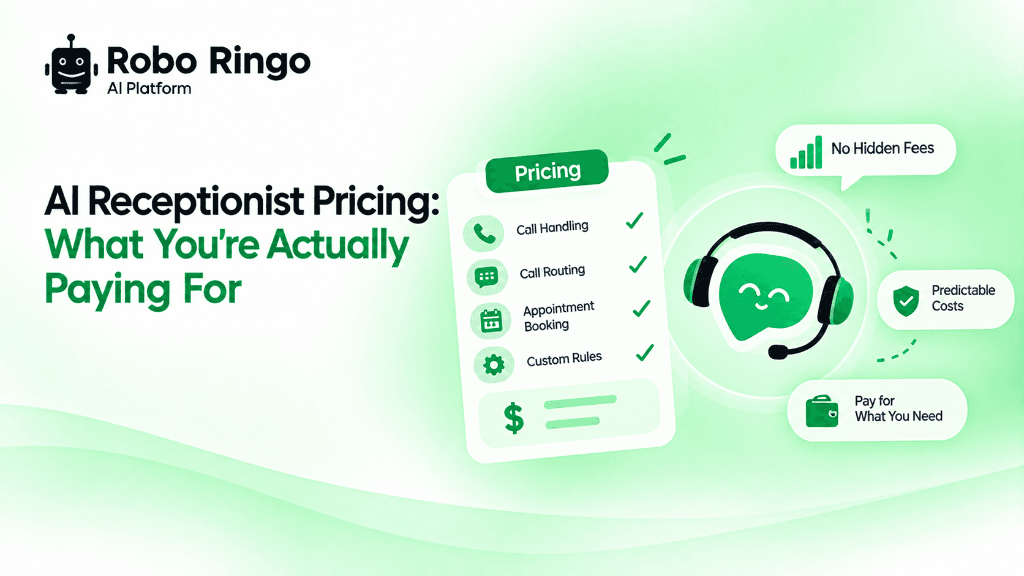
AI receptionists are sold under four main pricing models — flat monthly subscription, per-minute, per-call, and included-minutes-with-overage — and advertised pricing commonly leaves out 30–50% of the real monthly cost. Flat plans typically run $49–$500 a month, per-minute rates run roughly $0.05–$0.30 a minute (versus $0.75–$1.50 for a live human service), and per-call pricing runs about $2–$11 per call. Enterprise platforms built for higher call volume and multi-channel coverage are usually custom-quoted rather than listed on a pricing page at all.
The rest of this guide breaks down each pricing model, the fees vendors don't put on the homepage, and how to figure out which structure actually fits your call volume.
Key Takeaways
- There are four core pricing models: flat subscription, per-minute, per-call, and a hybrid of included minutes plus overage.
- The advertised number is almost never the full bill. Setup fees, number rental, integration costs, overage charges, and after-hours surcharges commonly add 30–50% on top.
- AI pricing undercuts live-human answering by a wide margin — roughly $0.05–$0.30/minute for AI versus $0.75–$1.50/minute for a staffed service.
- The right model depends on your call pattern, not the lowest headline price. Low, steady volume favors flat-rate; unpredictable or seasonal volume favors per-minute, with a cap on overage exposure.
- Enterprise platforms with multi-channel coverage are typically custom-priced, which trades upfront transparency for pricing matched to actual usage.
What Pricing Models Do AI Receptionists Use?
AI receptionist vendors bill in one of four ways, and comparing across models without converting to a common unit (cost per minute, or cost per month at your actual volume) is the single most common reason buyers get the comparison wrong.
| Model | Typical range | Best for | Main risk |
|---|---|---|---|
| Flat monthly subscription | $49–$500/month | Steady, predictable call volume | Overage fees once you exceed the included allowance |
| Per-minute billing | $0.05–$0.30/minute | Low or unpredictable call volume | Costs scale directly with every long or chatty call |
| Per-call billing | $2–$11/call | Businesses wanting cost certainty per interaction, regardless of call length | Expensive if calls run long, since duration isn't factored in |
| Included-minutes-with-overage | Base fee + per-minute overage | Businesses with a fairly consistent baseline and occasional spikes | Overage rates are often 3–10x the effective included rate |
A useful rule of thumb: flat-rate pricing tends to win for predictable volume, and per-minute tends to win for low or spiky volume. The crossover point is usually somewhere around 100–150 calls a month, but it depends entirely on average call length, so run your own numbers rather than assuming either model is cheaper by default.
How Much Does an AI Receptionist Cost Per Month?
Total monthly cost typically falls in the $25–$3,000+ range, and the main driver isn't the pricing model, it's the type of service:
- Basic, single-feature AI answering tools start as low as $25–$50/month for very low volume.
- Mid-market flat-rate or hybrid plans commonly land between $79 and $400/month, depending on call volume and included features.
- Hybrid AI-plus-human services (AI handles routine calls, a person steps in for complex ones) generally cost more, since human time is still part of the bill.
- Enterprise platforms with multi-channel coverage (voice, SMS, WhatsApp), CRM integration, and higher call volume are usually custom-quoted rather than published, since cost scales with usage and configuration rather than a flat tier.
What Hidden Fees Should You Watch For?
This is where an advertised "$79/month" plan quietly becomes $150–$200 a month in practice. According to industry pricing analyses, hidden costs commonly add 30–50% to the advertised price. The specific line items to check for:
| Hidden cost | What it typically looks like |
|---|---|
| Setup or onboarding fees | A one-time charge, sometimes waived on annual plans but rarely mentioned on the pricing page |
| Telephony and number fees | Carrier and phone-number costs billed separately, commonly $2–$15/month per number |
| Overage charges | $0.50–$3.50 per minute once you exceed your plan's included minutes, varying widely by vendor |
| After-hours or holiday surcharges | Some plans double or triple the effective rate for calls answered outside standard business hours |
| Integration fees | Charges for connecting to your CRM or practice management software beyond a basic tier |
| Per-seat or per-user charges | Relevant if the platform licenses by team member rather than by call volume |
None of this means every vendor hides fees deliberately — some genuinely don't charge several of these. The point is to ask about each line item by name during a sales call, rather than assuming the quoted number is the final one.
AI Receptionist vs. Human Receptionist: Which Costs Less?
AI answering consistently costs a fraction of a staffed alternative. One 2026 industry comparison put AI answering at roughly 60–85% less than live services for comparable call handling, and the per-minute gap illustrates why: AI services typically run $0.05–$0.30/minute versus $0.75–$1.50/minute for live-operator answering.
For context on the alternative AI is usually replacing or supplementing: the average in-house receptionist salary in the U.S. runs roughly $37,000–$41,000 a year (Salary.com, ZipRecruiter), before benefits, payroll taxes, or the cost of covering sick days and after-hours gaps. That's the real comparison point for a "is this worth it" calculation, not just AI pricing in isolation.
Which Pricing Model Is Right for Your Business?
- Low, steady call volume (under ~100 calls/month): Per-minute or per-call billing usually costs less than a flat plan sized for volume you're not using.
- Consistent, moderate-to-high volume: Flat-rate or included-minutes plans typically deliver better cost predictability, as long as the included allowance roughly matches your real usage.
- Seasonal or unpredictable volume: A hybrid plan with a reasonable included allowance and a capped or negotiated overage rate avoids both overpaying for unused flat-rate capacity and getting hit with steep per-minute overage.
- Multi-location or multi-channel needs (voice, SMS, WhatsApp, CRM integration): Custom enterprise pricing is usually the realistic path, since few flat consumer-style tiers scale cleanly to that footprint.
Questions to Ask Before You Sign
- What exactly is included in the advertised price, and what triggers an overage charge?
- Is there a setup, onboarding, or integration fee, and is it one-time or recurring?
- Are phone numbers and carrier costs included, or billed separately?
- Does pricing change for calls outside business hours?
- What happens to pricing if our call volume grows 2x or 3x next year?
- Is the contract month-to-month, or does switching mid-term carry a penalty?
How RoboRingo Prices This
RoboRingo uses custom, usage-based pricing rather than a published flat-rate tier, scaled to call volume, team size, and which channels you need — voice, SMS, and WhatsApp all route through the same platform with a built-in CRM, which is a different cost basis than a single-channel, per-minute voice tool.
Being direct about the trade-off: that means you won't find an exact number on a pricing page, and getting one requires a conversation with sales rather than a self-serve signup. The upside is that enterprise and multi-location businesses generally aren't paying for a tier built around consumer-scale call volume, or discovering overage fees after the fact. If a published, self-serve price point matters more to you than usage-matched pricing, that's a legitimate reason to weigh a flat-rate consumer tool instead, and worth factoring into your decision honestly rather than assuming one model is right for every business.
Frequently Asked Questions
Ready to see RoboRingo in action?
Handle calls, SMS, and WhatsApp with AI agents that work 24/7 — set up in minutes, not months.
Explore RoboRingo →