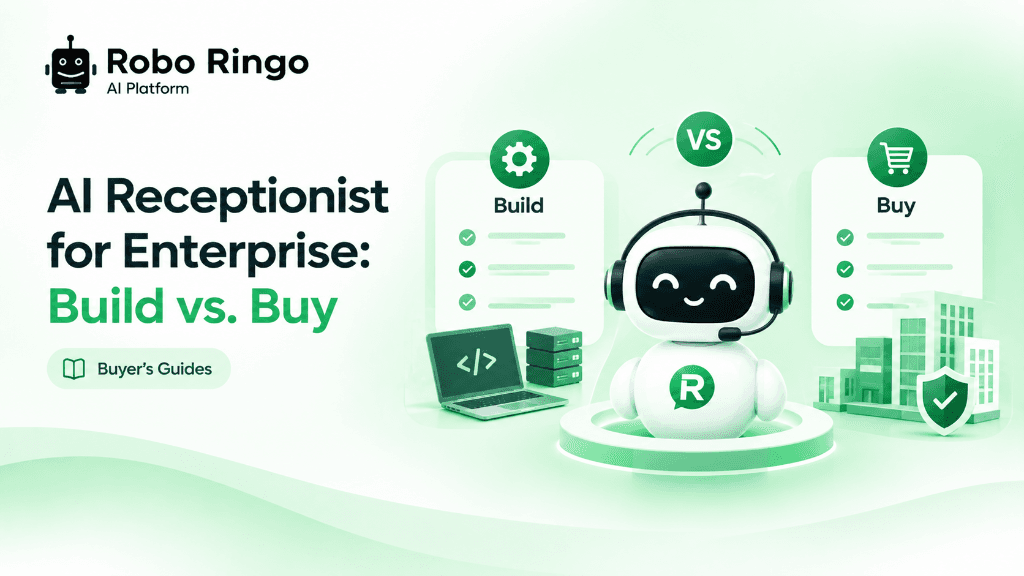
Building an enterprise AI receptionist in-house typically costs $250,000–$2 million in the first year and takes 4–9 months to reach production. Buying a managed platform costs a fraction of that, usually five figures rather than six or seven, and goes live in days to weeks. For most enterprises, buying wins on total cost of ownership and time to value — the exceptions are organizations running extreme call volume (5M+ minutes a month) or ones where voice AI genuinely is the core product, not a supporting function.
That's the short version. The longer version — where the real costs hide, what "buy" actually gets you, and when building still makes sense — is what determines whether your team makes this decision once or ends up revisiting it eighteen months from now.
Key Takeaways
- In-house builds cost $250K–$2M in Year 1 once you count engineering salaries, infrastructure, and the ongoing "maintenance tax" of keeping pace with model updates — not just the initial build.
- Managed platforms typically reach production in 1–10 weeks, versus 4–9 months for a custom build, because the telephony, speech, and orchestration layers are already solved.
- Advertised per-minute pricing on DIY voice AI stacks is rarely the real cost. Once you stack STT, LLM, TTS, SIP trunking, and platform fees, true all-in costs typically run 2–4× the headline rate.
- The break-even point for building tends to sit around 5M+ minutes of monthly call volume — below that, infrastructure amortization doesn't offset development cost.
- This isn't strictly binary. A growing number of enterprises land on a third path — a managed platform with custom configuration — rather than pure build or pure buy.
Build vs. Buy: The Decision Framework at a Glance
| Factor | Build In-House | Buy (Managed Platform) |
|---|---|---|
| Year 1 cost | $250K–$2M | $5K–$100K (typical enterprise range) |
| Time to production | 4–9 months | 1–10 weeks |
| Engineering team required | 2–3 dedicated senior engineers | None to minimal (config only) |
| Ongoing maintenance | 100% on your team, including model-drift fixes | Handled by vendor |
| Compliance & security hardening | Weeks of dedicated work, your liability | Typically included (SOC 2, ISO 27001, etc.) |
| Customization ceiling | Unlimited | High within platform constraints |
| Break-even point favors this path | 5M+ minutes/month, voice = core product | Nearly everyone below that threshold |
| Risk if the initiative stalls | Sunk engineering cost | Contract cost only |
What "Build" Actually Costs (Beyond the Engineering Team)
The number that gets quoted internally is usually the engineering team's salary line — and that alone is already substantial. A team of three senior engineers dedicated to a voice AI stack runs roughly $500K–$540K a year in fully loaded compensation, before infrastructure, tooling, or a single production incident.
What doesn't show up in that first estimate:
- The stacked API cost underneath your own platform. Even a custom build isn't free of vendor dependency — you're still paying for speech-to-text (roughly $0.004/minute), an LLM, a text-to-speech engine (often $0.06/minute or more for premium voice quality), SIP trunking, and per-number rental. These layers alone can push true per-minute cost to 2–4× what a simple internal estimate assumes.
- The "maintenance tax." As underlying LLM and ASR models update — and they update constantly — your internal code has to be adjusted to hold accuracy and latency steady. Teams that build in-house consistently underestimate how much ongoing engineering time this consumes, because it doesn't show up as a line item until months after launch.
- Compliance and security hardening. SOC 2 preparation, PII handling, and security review typically add 4–6 weeks of dedicated work on top of the core build — work that has to be redone or re-audited as the system evolves, not completed once.
- The 6–9 month "prototype-to-production" gap. Most enterprises underestimate how long it takes to go from a working demo to something reliable enough to answer real customer calls at scale. Internal pilots routinely hit what teams describe as a "complexity ceiling" — the prototype works, but scaling it to production reliability takes far longer than the prototype itself did.
None of this means building is a bad decision on its face. It means the true first-year cost is rarely the number in the initial proposal.
What "Buy" Actually Costs — Including the Part Vendors Don't Lead With
Buying isn't automatically the cheap option either, and a rigorous evaluation should price it out the same way.
Managed enterprise platforms typically land in the $5K–$100K range for a full first year, depending on call volume, seat count, and channel coverage — a large spread, but still an order of magnitude below a custom build in nearly every case. Time to production is the bigger differentiator: most managed platforms go live in 1–10 weeks, and some enterprise deployments are configured and running within days.
The genuine trade-offs on the buy side are worth stating plainly:
- Customization has a ceiling. You're working within what the platform supports, even if that ceiling is high. Deeply bespoke workflows that don't map to any existing configuration option are the clearest signal that buy alone won't fit.
- Vendor dependency is real. You're trusting another company's infrastructure, uptime, and roadmap. This is exactly the trade-off worth evaluating directly when comparing self-hosted, API-first, and fully managed approaches — they carry meaningfully different levels of control and operational burden.
- Switching cost exists, even if it's lower than unwinding a custom system. Evaluate integration depth and data portability before signing a multi-year contract, not after.
When Building Actually Makes Sense
Buy wins for most organizations, but not all of them. Building in-house tends to be the right call when:
- Call volume is extreme. Above roughly 5M minutes a month, infrastructure amortization starts to offset development cost in a way it simply doesn't at typical enterprise volumes.
- Voice AI is the core product, not a supporting function — if you're building a company around proprietary voice technology, owning the full stack is often the point, not a cost to minimize.
- Your workflows are so unique that no existing platform's configuration options come close, and an agency-built layer on top of a platform (a middle path, typically $30K–$150K and 4–10 weeks) still doesn't cover the gap.
For nearly everyone else — the large majority of enterprises evaluating this decision — those thresholds don't apply, and the math favors buying by a wide margin.
Questions to Ask Before You Decide
- What's our actual monthly call volume today, and realistically in 24 months — not the volume we'd need to justify building?
- Do we have 2–3 senior engineers we're willing to dedicate to this indefinitely, not just for an initial build?
- What's our tolerance for a 6–9 month gap between prototype and reliable production use?
- Does our use case require capabilities no platform currently offers — or does it just feel that way before we've evaluated one closely?
- If we buy, does the platform meet our compliance and integration requirements out of the box, or will we still need custom engineering work on top of it?
This broader enterprise buyer's checklist goes deeper on the questions that tend to surface only after a platform is already in production — integration dead ends and compliance gaps that don't show up in a demo.
How RoboRingo Fits the "Buy" Side of This Decision
RoboRingo is built on carrier-grade infrastructure — LiveKit, Deepgram, OpenAI, Twilio, ElevenLabs, and AWS — so the telephony, speech recognition, and voice generation layers an in-house team would otherwise have to assemble and maintain are already solved and already carrying a 99.7% uptime SLA. Most enterprise teams are live in about 15 minutes for initial configuration, with a dedicated solutions engineer for larger rollouts, rather than months of prototype-to-production work.
Because RoboRingo already carries SOC 2 compliance and ISO 27001 certification, the security-hardening phase that typically adds weeks to a custom build isn't a project your team has to run internally. And because voice, SMS, and WhatsApp route through the same platform with native CRM integrations (Salesforce, HubSpot, Zoho, Zendesk via MCP), the "buy" path here covers more of an enterprise's actual channel footprint than a narrow, voice-only build would — without asking your engineering team to stitch separate systems together afterward.
Worth saying directly: RoboRingo, like any managed platform, operates within its own configuration ceiling. If your enterprise's requirements genuinely fall into the "voice AI is the core product" or "5M+ minutes a month" category discussed above, that's a real build case worth taking seriously — this platform is built for the large majority of enterprises that fall outside those thresholds, not as a claim that buying is always the right answer for every organization.
Frequently Asked Questions
Related Reading on RoboRingo
- The Enterprise Buyer's Checklist: What to Ask Before Choosing an AI Receptionist
- AI Call Handling Platform Evaluation: Self-Hosted vs. API-First vs. Managed
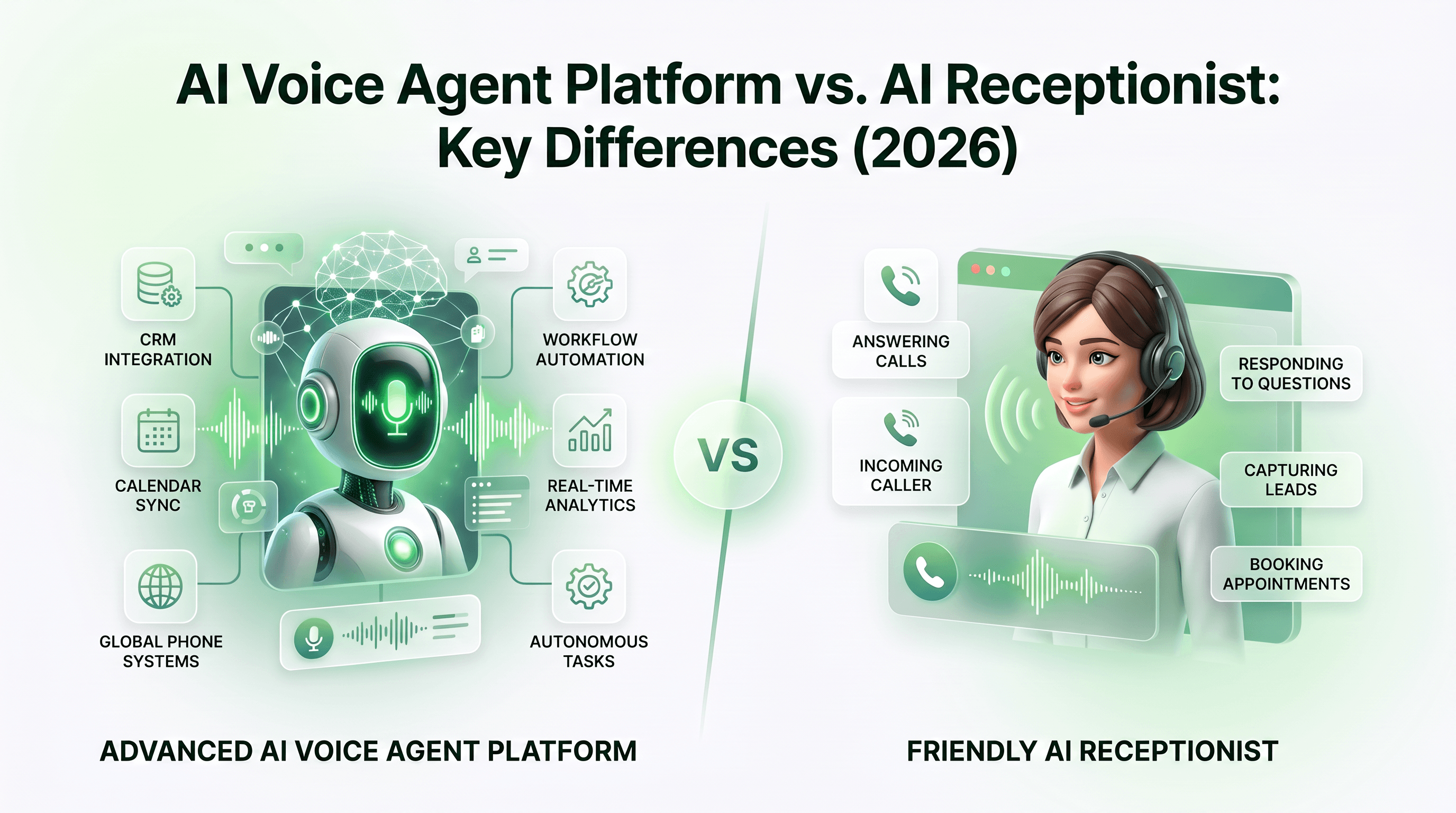
- AI Voice Agent Platform vs. AI Receptionist: What's the Difference?
- RoboRingo vs. Bland AI: Comparing an Enterprise AI Call Platform
- Scaling Call Coverage Across 10+ Locations Without Hiring 10+ Receptionists
Ready to see RoboRingo in action?
Handle calls, SMS, and WhatsApp with AI agents that work 24/7 — set up in minutes, not months.
Explore RoboRingo →